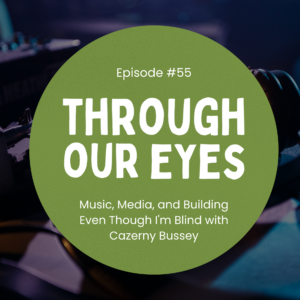
Season 3 | Episode 55
October 21, 2026
Cazerny Bussey lost his eyesight at 15. He was a sophomore at the Frank Sinatra School of the Arts in New York City, already performing, already building something. Losing his sight could have stopped all of it, but it didn’t.
In this episode, Cazerny — Brooklyn-born recording artist, author, speaker, father of five, and Founder and CEO of Even Though I’m Blind, Inc. — shares how losing his sight became the beginning of a bigger vision. He talks about graduating with his class when no one knew how to accommodate a blind student, growing up with a blind father who was his superhero, and building a media organization dedicated to changing how the world sees blind and visually impaired people.
Learn more by visiting eventhoughimblind.com and find them on TikTok, Instagram, and all major podcast platforms.
Want to be a guest on the podcast? If you or someone you know has a story to share — whether you’ve experienced a pediatric retinal condition yourself or are raising a child who has — we’d love to hear from you. Reach out to us at throughoureyes@prrf.org.
You can find more episodes and ways to get involved with the Pediatric Retinal Research Foundation here: https://linktr.ee/throughoureyespodcast
Transcript
Luisa Recchia: Welcome to Through Our Eyes, a podcast from the Pediatric Retinal Research Foundation, where we share stories of hope, resilience, and possibility. I’m Luisa Recchia.
What if losing your sight helped you discover an entirely new vision for your life? My guest today, Cazerny Bussey, experienced retinal detachment at just 15 years old, forever changing the path he imagined for himself. But rather than allowing blindness to define his future, he discovered a purpose that reaches far beyond his own story.
Today, Cazerny is a musician, author, father of five, and founder of Even Though I’m Blind, an organization dedicated to amplifying the voices, talents, and achievements of the blind and visually impaired community.
In our conversation, we explore the influence of family, the importance of believing in what’s possible, and the powerful role parents play in helping children develop confidence and independence.Cazerny reminds us that while sight may change, our ability to dream, contribute, and lead does not. Here’s our conversation.
Well, welcome, Cazerny. Let our listeners know about you, your journey, specifically your journey with blindness.
Cazerny Bussey: Yes, absolutely. Well, before that, I would like to thank you, Luisa, for having me on the platform. I really do appreciate it. Uh, these platforms are really important, you know, just to, uh, you know, get the message out and the vision.
And, um, that’s what Even Though I’m Blind is about. But, um, me, myself grew up a regular kid, very active out in Brooklyn, New York. Uh, at the age of, uh, five years old, my father recognized that, uh, I had a ability to sing beautiful music, so he, um, quickly started to take me under and develop me. Uh, my father was, uh, a part of the old-school rap group, Stetsasonic.
So, you know, for him it was like music was a [00:01:00] passion. It was a thing for him. Me, you know, I was just a young kid, you know. Uh, he would like get me to sing this song, I tell this story a lot, by, uh, the, the s- the group Xscape, called Run To The Arms. At that time I had a real squeaky voice, right? So I was singing like female songs.
And when my family would come over, he would say, “Cazerny, come out here and sing,” you know. And I would be like, “I just wanna play Mario,” you know. I didn’t really wanna… But, you know, I say, I tell that story because, you know, I had a, a, a fairly, you know, normal life growing up. You know, a kid. I, you know, and as I, you know, 12 years old come, and I’m like, okay, well now I’m a little older, junior high school I put I record my first song professionally in a- Ooh
professional studio that, you know, I actually, um, wrote the music. And for me it was just like a, a kinda life-changing experience. At this time [00:02:00] I’m, like, more into music ’cause I’m a little older. But even then, I would probably rather be outside and playing football with my friends. Um- Yeah
I’m speeding up with the story because I auditioned to be in the School of Performance Arts, Frank Sinatra, here in, uh, New York City and Long Island City. And I- Wow … I made it in there, you know- Mm-hmm … through vocal, which was like a dream of mines because I was like- Wow. Yeah. I get into school the first freshman year.
It’s a wonderful environment. The environment is like artsy, a lot of, uh, performance art students, singers, actors, actress, dancers. It was just so great, and it was a very new school. Tony Bennett had, uh, founded the school actually at the time. And, um-
yeah, by the age of 15 years old 15, I, I lost my eyesight through retina detachment.
I went to the eye and ear infirmary out in New York City, [00:03:00] and, from the first surgery they went in, they patched my eyes up. I was sent home. They said the, the sight will come back in a couple of weeks. Long story short, it came back in a couple of weeks. I went back, had to do another surgery to deal with, like, scar tissue and, you know, they had to reattach the retina and, um, I went back to the eye and ear infirmary Yeah, Dr.
Rosen, which was my doctor at the time, he told me that, um, ” Yeah, your optic nerves is dead, so you’ll no longer be able to see.” You know, that was, like, very life-changing for me. It was, like, one of them moments that I just kinda … I lost a lot. I lost a lot, I gained a lot at the same time. It was a loss and it was, like, a real big gain because it was like, on one hand, I was, like, in this school, sophomore in [00:04:00] this school, so excited to be in there.
I kinda lost the excitement for everything at the time, but I did gain this, this vision. You know, I grew up, it was like, okay, now not only am I in this school because I love music, but now I have to figure out a way to keep up with the students in my class and, you know, I have to … I just have to succeed.
I have to pass my grades. I have to graduate. And that became, like, my focus at the time. So it was, like, a really big shift. I like to tell people the day I realized that I wouldn’t be able to see physically, I lost my sight, I gained a vision that day. Speeding past out of high school, I was able to keep up, graduate with my, my graduating class.
Uh, they offered me To go to this school for the blind out in the Bronx. I declined, so they did send me the accommodations I needed. And [00:05:00] yeah, I graduated. And thanks to, like, the great support because I had a great support, and they was really skeptical because they never dealt with a blind student. But the reason why I tell this story, this whole story, and I did speed up through a lot.
But I tell that to say once I graduated out of the school, it was this young lady by the name of Valeria who was totally blind, and they accepted her with open arms, and they was just so ready for her, you know? And at that time I didn’t know I was, like, paving a way, you know? Oh. I just was trying my best to succeed, and just to keep up and try to live as normal as I, I could at the time.
And here Valeria comes in blind, and she’s, like, coming to the school. I’m like, wow. So you know, I, I think back these days and I say, you know, sometimes it takes for you to be that leader, that trendsetter, you know, to, [00:06:00] to pave the way and open doors for future opportunities and, you know, um… Yeah, that, that, that was like my, my young age coming up.
I was doing so many different shows around the country at a young age, like when I was around 15 years old. Yeah. I was performing in different spots. You know, when I lost my sight it was just, you know, it was all eyes on me at the time. You know, when I first lost my sight I didn’t never have a time to sit down and mourn and cry because my life was just so active and I had to, like, just continue on.
I had to keep going. That’s- You know? I had to keep… Like I said, I had to keep up. You know, I didn’t wanna be, I didn’t want my life to end. I didn’t want it to stop, and it didn’t because I’m here today, you know?
Luisa Recchia: Oh, wow. Wow. Almost like it’s a, it’s been a gift for you, to allow you to path the way for other paths create a path for others.
And your persistence, that’s amazing.
Cazerny Bussey: Yeah, I, now that [00:07:00] I’m into this thing, I realize these things, and I think this is a lot of the message I’m trying to hand off to the people is that you know, it could be kind of a positioning of sort. Like, uh, you know, it happened to you for a reason. You know, you, you just gotta make sense of it all.
Um, especially when you have like a father and mother and family like mine that, you know, they really instilled in me that, you know, I was here with a purpose. You know, I had, it w- I did have something greater, and you gotta kinda find that within yourself regardless to, you know, the circumstance you may find yourself in at the time.
Like I said, I was able to impact so many people, s- since I lost my sight, i’m talking about people that are sighted, people that had low vision, you know, all different religions and just everybody ’cause it’s like-
Luisa Recchia: Mm …
Cazerny Bussey: my thing is that, I don’t see with sight, but I see with vision.
And then there’s a lot of people [00:08:00] out there that have sight and they kinda like, you know, they’re lacking that vision. Yeah. Or sometimes people are blinded by, you know, the things they see. Like, they might be in a situation and it might seem like the end of the world to them because that’s the only thing they could see for they self at the time, right?
Luisa Recchia: Mm-hmm.
Cazerny Bussey: And, you know me, as a blind person, sometimes I’m forced to see beyond the things that’s right in front of me. I have to kinda feel around the environments I’m in and create the mental map in my mind and then develop from that moment a- and even beyond. So for us to have that positioning, that lack of sight gives us that vision offering to the world.
And, uh, I’ve been preaching that a lot lately ’cause it came to me as like, as blind people, blind and visually impaired people, we are not liabilities. Like, we’re assets. We have a unique offering to contribute to society at large. Like, sometimes you might look [00:09:00] at a smile and be deceived by that smile, or look at a grin and that grin might push you back from a great opportunity.
But we have the ability to see beyond that physical thing and tap into a, you know, the deeper aspect of everything, you know? And, uh- it, it shows through these, uh, these, these people that I’m dealing with because they got different organizations that they’re building. Um, I’m- connected with different people who’s building different technologies.
And I, when I first got in, uh, Even Though I’m Blind, and I started doing my research, um, the research is where, uh, actually put me to the point where I was led to start the organization. ‘Cause it’s like I started researching, right? And I said, ” I know I’m not the only blind person in the world,” right? ‘Cause a lot of these, uh, you know, from 15 to now you know, to three- Yeah
up until three years ago, I was like the only blind person in every room I was in. Yeah. There was no other blind people there, [00:10:00] and I was like- No … this just can’t be. You know? I mean, I know I can’t be the only cool blind guy in the world, you know?
Luisa Recchia: Well, you’re not. No. I’m not.
Cazerny Bussey: Look, I did my research, right?
Luisa Recchia: Oh.
Cazerny Bussey: I bumped into the Google lawyer. I was like, “Oh, guess I’m not.”
Luisa Recchia: Yeah.
Cazerny Bussey: The Google lawyer was blind, right? And he was from New York. I said, “Wow, that’s a pretty cool position,” you know? Like, to be the lawyer of Google.
Luisa Recchia: Yeah,
Cazerny Bussey: right. Totally blind. I started looking up, finding Harvard students, and like I said, uh, scientists, technologists, and business owners.
You know, it was just a whole world- Mm … of just like… It was like wow, this is amazing. And you know, when the world thinks- Yeah … about a blind person, they only model, they have is, like, Stevie Wonder, Ray Charles. And shout out to them, but it’s like a lot more going on than just that, you know?
Luisa Recchia: Yeah.
Cazerny Bussey: Uh- I was like we gotta get this out there.
We gotta show the [00:11:00] world, you know, and change the perception. A lot of times people see the, the, uh, the white cane and, you know, they judge the person by that cane, and it’s like a real energy and force behind that. It’s a real vision behind them things, and I feel like we all have the right to be viewed as who we are, not, you know, our circumstance.
Luisa Recchia: So true.
What do you hope someone who’s newly blind or just losing their vision or, uh, raising a child with a visually with a visual impairment might take away from, from everything you’ve learned and all your research?
Cazerny Bussey: Oh, man, I hope that they would really know that, uh, they are really amazing. They’re great.
They’re here for a reason. And that they have- you know, people behind them that will learn from the moves they make. The ones that are younger, [00:12:00] that’s growing up learn from the, uh, you know, us- us trailblazers, us trendsetters, the ones that’s paving the way. And then the ones that are younger, we look to them, for the passion and desire ’cause we wanna make it a better, more accessible, more equality level of living for them all.
So like, it- it all comes together in the end. I just want them to know that they’re not alone. You know? Um, it’s a community out here that is not only, you know, rooting for the success of the blind and visually impaired community, but there’s also a world out there that is ready to open up and embrace and to see, and, and to see what we got.
Uh, I did a listening party not too long ago. I think it was about two to three weeks ago. And uh, it was, it was Busta Rhymes. He’s a, um… I- I mean, I- I think everybody might know Busta Rhymes, but he’s a really influential hip hop artist, and I [00:13:00] was invited. I actually post the the footage of the encounter on, all of our socials, so you can find this encounter.
And I went to this listening party. He was dropping his new project, and they put me on the panel and, um, to ask him a question. And I takes the opportunity, the great opportunity to present vision. Mm-hmm. So I says to Busta Rhymes, I say, “So you know, Busta, us blind people, us blind and visually impaired people, we’re- we’re- we’re kinda forced to live through vision because without that vision, we’re really in darkness.”
Mm-hmm. Like, it’s already dark, but without a vision, it’s pitch black. Like, it’s nothing. Oh. It’s void, you know? And i- I had to ask him like, “So how did your vision guide you through life?” And Busta was like, “Wow.” You know, he- … he was flabbergasted because he, you know, he… I don’t know what he thought I was gonna ask him, but he said [00:14:00] That he almost didn’t know how to answer the question, but then he said he almost wanna ask me how I move and how I navigate.
And he said, he is willing to learn, and that was the, that was the part right there. You know, that’s why we had to share the clip because it’s like people as influential as Busta is willing to learn, about how us blind and visually impaired people see through our vision or how we operate or how we guide and led through our vision.
And these are like the rooms where like Even Though I’m Blind Incorporated plans to, you know, bring our stories to because we are a media outlet and, um, yeah, we’re using media to really change the perception of how we’re viewed, like I said in the beginning We’re more than the white cane. And a lot of times the white cane is our friend.
They’re coming up with different [00:15:00] technologies that is revolutionalize- lizing travel, right? Yes. But it’s not about the travel destination, it’s about the destination and the goal that we’re planning to get because we not… The cane just helps us to get to this place that we’re headed to.
Luisa Recchia: Yeah.
Cazerny Bussey: And a lot of us are headed to places with purpose and for reasons, right? We- Mm-hmm … we’re headed somewhere for a reason. And, uh, yeah, the Even Though I’m Blind Media organization is like that. Like, and I always tell everybody that without these wonderful, amazing stories, I really wouldn’t have this organization because it’s not a organization, you know, for me.
It’s a organization from us as a collective. It’s our great stories that is gonna change the perception and the way the world view us and, the way shape the way they interact with us and, you know, the accommodations. Like, you know, us being like more [00:16:00] prominent in the conversation of society, human first, you know? And everybody got different challenges and that don’t got nothing to do with, you know, the disability or the quote, unquote, “handicap,” but everybody, and even us as blind people… my partner Ariana Dewberry said she’s, you know, she’s in college. She lost her sight a little later on in life, and she said so when one of her classes was over, um, the bell rings, and she’s like the blind student in the class, and she heads to the door, and she holds the door open for others- Ah
to walk out the room, right? And they like, “
Luisa Recchia: Wait,
Cazerny Bussey: you’re holding the door for us?” She’s like yeah.”
Luisa Recchia: Yeah. What a great story. Tell our audience a little bit about how they can find Even Though I’m Blind, what they can find when they’re there, ’cause I love the story you’re sharing. And where can they find that question you asked?
Cazerny Bussey: Absolutely. [00:17:00] Well, yeah, these stories is all being documented, like I said, and, uh, we- we’re shaping them into media pieces.
You know, the power of media has a great influence to program and shape, like I said, perception, and that’s really what we’re trying to do. And that’s, that’s what we’re doing. Even Though I’m Blind.com, that’s the hub. Social media everything, uh, everything, the TikTok, Instagrams, and we also have a podcast called the Even Though I’m Blind Experience where we start to, you know, get more in depth with these great human beings, these, uh, personal brands.
They are on every platform as well that streams podcasts. Also on the site you can find the episode. Um, we have a 24/7 radio station that plays all blind and visually impaired artists. Mm-hmm. And we have about [00:18:00] 45 artists streaming through that right now, which is all great artists. Who would’ve thought that there were more than just Stevie Wonder and Ray?
Well, they, there is. There, there definitely is, you know? And they’re, they’re great on a lot of different levels. And we also have, directory on the website that, um, you know, uh, displays these services and also businesses, organizations, personal brands, uh, even podcasts. So it’s a hub for all things blind and visually impaired led, owned, or services that serves the community because, you know, really we, we wanna be that.
You know, we wanna bring the resources to the forefront. Like you said you deal with the, the younger generation as well, and a lot of them might not know that a lot of these services is available. We’re trying to make it more accessible and reachable, you know? [00:19:00] Um- Yeah … well, we- the, the list is pretty new, you know?
Um, it’s really accessible. We’re trying to have a, a long list of great services and, and things, you know, and, and hope to see so many more businesses being developed and so many more jobs being open, you know, for the blind. So, you know, that directory is there as well. We got an, a event sector where we are doing events.
Um, I partnered up with, uh, the first, um, mainstream record label for blind and visually impaired. Uh, my partner, Big Saint. Uh, we just did a wonderful event out in Texas for, uh, the NFB convention, and it was a great success. Uh, we’re, we’re formulating a documentary right now, which we are planning to pitch out to, you know, all the film festivals and media outlets and Netflix.
Basically [00:20:00] we just see- I’m bringing these professional cameras in to professionalize and to normalize the image of the blind and visually impaired because we want this to be normalized. We wanna be more accepted.
Luisa Recchia: Yeah. I have to ask because, uh, uh, yeah, I love your energy, and I love all of what you’re building. And I love the fact that you haven’t let anything get in the way of the success you’ve had thus far.
But I also know that it’s very difficult for someone to do that alone, uh, which makes me believe and think, you talked about your dad. So it sounds like you had a pretty good support system that, that wouldn’t accept no from you, right? They wanted more of you and more for you which may have been what helped you strive and persist To be the success you are today.
Am I accurate in [00:21:00] that?
Cazerny Bussey: You’re absolutely accurate. Yeah? And it’s, it’s funny, you’re the first one that actually brought up the topic of my dad, and I’ve been doing a, a, a really big- … media run. And my dad is actually blind himself. He lost his- Oh … sight at seven. So when I-
Luisa Recchia: Wow …
Cazerny Bussey: you know, like, when I say, you know, when I tell a story I say, like, I be telling people that I was the only blind person in these rooms and I didn’t re- when I was growing up with my dad I couldn’t see my dad as a blind person.
My dad was a superhero. You see what I’m saying? Yeah, yeah. And my dad was so much in, like, to the industry. And, and my dad, you know, um, not, I don’t, I’m not gonna say this is a good thing, but it was his thing. He really was not, and this is why I didn’t g- I didn’t move through the blind community.
My dad didn’t believe in a, a room full of blind people. You know? He believed that wasn’t the real world and, you know, he, tried to keep me a- You know, he, he kept his self [00:22:00] away from it and he kept me away from it. And, um, but yeah, he raised… It was a time when he raised six of his kids on his own.
You know, he was a single dad. Wow. And he c- he was just amazing, you know? He was like- He was a hero and, and loved by everybody. You see his nieces and nephews, you know, he’s like the favorite uncle, you know? Uh, to this day the, the music connects that I have came through him. And RIP to my dad, I lost him not too long ago.
And-
Luisa Recchia: I’m s- sorry to hear that …
Cazerny Bussey: you know, but, but he lives through me. And, and I have his name as well, you know? Mm-hmm. ‘Cause Ernie. So I am a junior. But he, um, yeah, he was such a big influence, and that’s so important. It’s like, uh, you know, I would say, you know, and anybody that know me know that my dad is just like, you know, he was my everything.
He, he, it’s like I’m a splitting image, right? But, but I will say that I, I don’t wanna create a blind world at all. I’m not really into that. [00:23:00] I, I’m not, like, into, like, making this world a world full of blind superheroes, but I, I do know the importance of what I’m doing through this media and- Mm-hmm
and through this organization, right? Through this mission. I don’t wanna create a blind world, but I do wanna, we do have to fight against the discrimination. You see what I’m saying?
Luisa Recchia: Yeah, yes.
Cazerny Bussey: Yeah. ‘Cause although my father didn’t go through it, a lot of people is, you know?
Luisa Recchia: So- Yeah. And I ask that because, you know, a lot of our listeners are parents and, and some of them, many of them actually, obviously their children because we are a pediatric retinal research foundation, many of them are young children, so their parents are listening to this podcast.
So I often like to ask, you know, what advice would you give a parent who wants to support their child’s independence while obviously also naturally wanting to protect [00:24:00] them? So as a young adult yourself or a man yourself who has been successful what would, what advice would you give a, a, a parent who just heard that their- young child, uh, may be blind soon or is already.
Cazerny Bussey: Wow. That’s- that’s heavy, and I could say I am a young man. I have five children. I have a 16-year-old. My first set of twins are gonna be 13 wow. And then I have a second set of twins that are 11, right? And I actually just got featured in uh, the Dads Fathers platform as a upstanding dad.
Uh, they featured me, and they did a writeup on me, and, uh, you know, we did a recording and stuff like that, and they a pretty big platform. And of course they featured me because it’s like, uh, well, as a blind dad, as a blind dad, as a blind dad- Mm … you’re still able to be such a [00:25:00] achieve, and it’s like, wow. I never thought about, you know, even me having a father that was blind and me being a blind son, I never thought about the situation of, you know, me having a situation where I heard that my children, you know, one of my children would be losing they sight.
See what I’m saying? No. And that- that- that could be very heavy. That could be very hard. Mm-hmm. And I would say quickly that- Mm … um, yeah, my father was a great example for me, so parents are great e- my mother too, sorry. I love my mo- RIP to her too, but parents are the core of the household.
You know? We are the foundational core of, you know, the- the shaping of what our children believe, you know, um, how they grow, how they, you know. So we- we’re they- we- we’re their foundation, so I would tell you to treat them like a human being [00:26:00] first. Treat them like somebody, not… Don’t treat them like a blind person.
But I probably have more joyful… just to know that, you know, joy comes in the end, you know? It, like, keeps me up, and- Mm … I say, “Oh, well, a challenge is coming.” That means it’s my opportunity to overcome, right? Every great story came with a, a, a great challenge. I don’t know one that didn’t, so just get ready for the great outcome of that child and, and see them in that way. And as you see them in that way, the f- the influence that you have as, as a parent would, would give them the ability to see theirselves in that way. Mm-hmm. And just see them as a success. I didn’t say tell them that they gonna be a singer because you are, or a lawyer because you are.
But just let them know that they’re bigger than, you know, they’re bigger than it all. And, uh- Mm … just assist them in everything, you know? And, and learn with them. ‘Cause, you know, a lot of these blindness techniques could help us out, you know? Like, it help, it helps the [00:27:00] sighted.
Luisa Recchia: Mm
Cazerny Bussey: that even though they blind, you know, they, they-
Luisa Recchia: Mm …
Cazerny Bussey: they’re great, you know? And, uh, you just gotta take it and run with it.
Luisa Recchia: Yeah. You help us see things that we don’t see.
Cazerny Bussey: Exactly. Exactly.
Luisa Recchia: Looking ahead, what are you most excited about?
Cazerny Bussey: Man, I’m just excited about life, you know, the technological advancements that’s happening.
I do feel like the voice, and we, you know, we title ourself, you know, we say the leading global voice because I do feel like that voice, that one voice collective, I think that is gonna echo to the four corners of the earth.
Luisa Recchia: Mm.
Cazerny Bussey: You know? And I think that, that, that voice is gonna really make a difference in the world, and I’m just so excited to see what that difference is gonna be with the impact of the vision being presented, right?
Luisa Recchia: Mm-hmm.
Cazerny Bussey: The vision of things. Yeah. Because like I told Busta Rhymes, we are [00:28:00] forced to live through this vision, right? And sometimes the ones that are sighted is blinded by the sight and what they see.
Luisa Recchia: Mm.
Cazerny Bussey: So when you look at it on that level, it becomes way bigger than a podcast. It’s like a real- … shift that’s happening and, you know, the, the shift is happening in the world.
It’s been hap- happening for a long time, you know? We’re not in the caves, you know, no more, so things are, are changing and I just wanna see us there. Mm. When that shift happen, and I know we will be there, and it’s, I, I’m just excited to, to see that future that we’re aiming towards.
Luisa Recchia: Beautiful. Cazerny, it’s such a pleasure to have you on our call today. A blind creator, author, father of five, a nonprofit leader. Oh my gosh. You do have a vision. For those of you listening please reach out to eventhoughimblind.com and listen to more about [00:29:00] Cazerny and, uh, all the stories that he’s sharing.
What an inspiring conversation with Cazerny. One of the things that has stayed with me was something that he shared about losing his sight, “I lost my sight, I gained a vision.” And perhaps that’s the message I hope every parent, every young person, and every family listening takes away from today’s conversation. A diagnosis may change the journey, but it doesn’t have to define the destination.
As parents, mentors, and advocates, we have an incredible opportunity to help young people recognize their abilities, discover their strengths, and believe in a future filled with possibility. Dizurni’s story is also a reminder that none of us achieve success entirely on our own. Encouragement, community, and people who believe in us can make all the difference.
To learn more about Cazerny and the incredible work of Even Though I’m Blind, visit eventhoughimblind.com.
And to learn more about the Pediatric Retinal Research Foundation and the resources available to families, visit prrf.org. Thank you for joining us on Through Our Eyes. Until next time, let’s continue to see beyond limitations and recognize the possibilities in every individual.







 Deutsch
 English
 Español de México
 Français
 Nederlands
 Português
 简体中文
 日本語
 Русский
 Italiano