By Alexis Ortiz
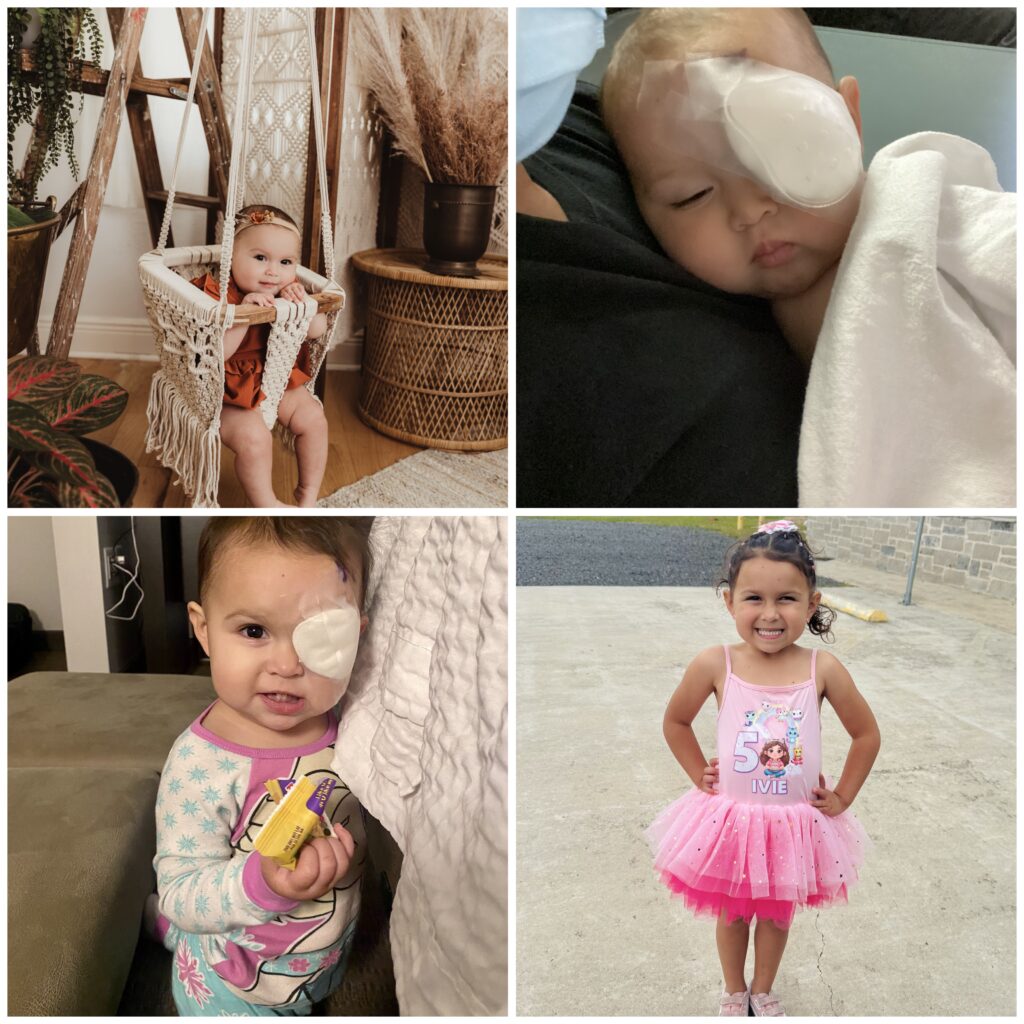
At just 8 months old, my daughter Ivie Rose’s life — and ours — took a turn I never could have imagined. This is the story of how we learned she had Persistent Fetal Vasculature (PFV), a rare eye condition.
The First Sign: My Baby’s Eye Drifting Outward
I began noticing that her left eye was lagging behind her right eye and suddenly drifting outward (known as strabismus). People reassured me that it was probably just a lazy eye and that I shouldn’t worry. But something about the sudden change didn’t sit right with me. As a mother, I couldn’t shake the feeling that something wasn’t right, so I took her to her pediatrician.
No Red Reflex: An Urgent Referral
During her assessment, her pediatrician noticed that Ivie’s left eye was not showing the normal red reflex. She recognized how concerning this finding could be and urgently referred us to a pediatric ophthalmologist.
Fearing Retinoblastoma
What followed was every parent’s nightmare.
After examining Ivie, we were told she had a vitreous hemorrhage — bleeding inside the eye — and that her clinical signs were concerning for retinoblastoma, a rare childhood eye cancer. We needed an ultrasound as soon as possible.
The ultrasound revealed a mass in the back of her eye that appeared to have caused her retina to detach and her eye to fill with blood. Suddenly, we were facing the possibility that our baby girl could have cancer.
We were referred to Houston to see a highly experienced pediatric retina specialist and surgeon. After examining Ivie, he confirmed that there was a mass, but the blood inside her eye made it difficult to determine exactly what we were dealing with.
An Impossible Decision About Surgery
Our next step was an examination under anesthesia with her retina specialist and a well-known pediatric oncologist from MD Anderson. After that examination, we were told that the oncologist was 95% certain the mass was not cancerous. But there was still no way to know for sure without surgery to drain the blood and examine the tissue.
Even though the doctors felt hopeful, there was still a terrifying possibility that it could be retinoblastoma — and that proceeding with surgery carried the risk of the cancer spreading if that was what she had.
We were faced with an impossible decision. We could remain in uncertainty, or we could move forward with surgery knowing there were risks either way. We chose to move forward because we needed answers. We needed to know what our little girl was facing so we could make the best decisions for her future.
The Diagnosis: Persistent Fetal Vasculature (PFV)
After surgery, the tissue was sent for biopsy. The mass behind her eye turned out to be scar tissue that had pulled her retina away. The biopsy came back negative for cancerous cells.
I cannot fully describe the relief of learning that our daughter did not have cancer.
Instead, Ivie was diagnosed with a severe form of Persistent Fetal Vasculature (PFV), a rare developmental eye condition in which blood vessels that normally disappear before birth remain inside the eye that, in her case, had caused significant damage to her left eye.
Three Eye Surgeries to Save Her Retina
But that was not the end of her journey.
In 2022, Ivie underwent three eye surgeries for retinal detachment, in an effort to repair her retina and preserve whatever vision might be possible. Her retina did not stay attached after the first two surgeries. Her third surgery, when she was just 18 months old, required the removal of her lens as well as a cataract.
We held our breath and hoped that this time would be different.
And it was.
Her retina stayed attached.
That surgery was a success, and her retina has remained attached ever since. Although Ivie has no vision in her left eye, we are forever grateful for how far she has come and for the medical team that helped us navigate one of the scariest seasons of our lives.
Ivie Today
Today, Ivie is 5 years old.
She is so much more than her diagnosis. She is a little girl with a whole life ahead of her, and PFV is only one part of her story.
There are things about her journey that I will never forget: the fear of hearing the word cancer, the uncertainty of waiting for answers, the weight of making decisions no parent should ever have to make, and the prayers that carried us through each surgery.
I also will never forget the feeling of knowing that something wasn’t right and choosing to speak up for my daughter, even when others told me not to worry.
Advice for Parents: Trust Your Instincts
If there is one thing I hope another parent takes away from our story, it is this: trust your instincts. You know your child. If you notice a sudden change or something that doesn’t feel right, don’t be afraid to ask questions and seek answers. You are not overreacting by advocating for your child.
Why PFV Awareness Matters
I am sharing Ivie’s story because PFV deserves more awareness. I want other families facing this diagnosis to know that they are not alone, and I want people to understand that behind every rare diagnosis is a real child, a family, and a journey that may be filled with fear, uncertainty, difficult decisions, and hope.
Our journey has not been the one I would have chosen for my daughter. I wish I could give her vision in her left eye. I wish she had never had to undergo a single surgery. But I am endlessly proud of her, and I will never stop advocating for her and celebrating every part of who she is.
A Letter to Ivie Rose
Ivie Rose, you may never remember the battles you fought when you were little, but I will remember every single one. I will remember how tiny you were, how much uncertainty surrounded us, and how bravely you made it through something so big.
You are not defined by what you cannot see. You are defined by the beautiful little girl you are, the life you are living, and all the possibilities still ahead of you.
Follow us on Facebook: Ivie’s PFV Journey







 Italiano
 English
 Español de México
 Français
 Deutsch
 Nederlands
 Português
 简体中文
 日本語
 Русский