
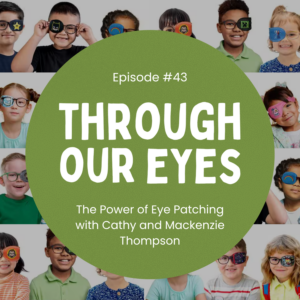
Season 3 | Episode 43
March 27, 2026
What does it actually take to get a toddler to wear an eye patch every day for five years? According to Cathy Thompson, founder of Patch Pals, it takes routine, distraction, flexibility, celebration — and a patch that a child actually wants to wear.
In this episode, Cathy and her daughter Mackenzie share the story behind Patch Pals: how a cataract diagnosis led to a daily patching battle, how Cathy’s homemade solution changed everything, and how that idea grew into a business that has quietly reshaped how families and doctors approach amblyopia treatment. Now in her thirties, Mackenzie reflects on her patching years and offers a message directly to the kids and parents who are in the thick of it today.
Whether you’re just starting the patching journey or struggling to stay consistent, this episode is the encouragement and practical guidance you deserve to hear.
To explore the Patch Pals collection of patches, resources, activity ideas, and their community of happy patchers, visit PatchPals.com.
Join us April 17-19, 2026 for a powerful weekend that educates, inspires, and unites. Saturday’s Family Connection Conference brings education and resources to families affected by pediatric retinal diseases, while Sunday’s Hope for Vision Walk brings together our community to fund critical research and programs. Participate in one or both events, either virtually or in person at Oakland University in Rochester, MI: https://prrf.org/upcomingevents/united-in-hope/
You can find more episodes and ways to get involved with the Pediatric Retinal Research Foundation here: https://linktr.ee/throughoureyespodcast
Transcript
Luisa Recchia: [00:00:00] Welcome to Through Our Eyes, the podcast of the Pediatric Retinal Research Foundation, where we share stories, resources, and conversations that support families navigating childhood vision challenges. Today’s episode is a special one. We’re joined by the founder of Patch Pals, a company that grew out of one family’s journey with childhood vision treatment.
But today you won’t just hear the story from the parent’s perspective. You’ll also hear from the daughter who inspired it all together. They’ll share what it was really like to live through the patching journey and how that experience turned into something that is now helping children around the world feel more confident during treatment.
Well, take us back to the beginning.
Uh, what was, what was happening in the family and, and what led you to create Patch Pals?
Cathy Thompson: Back almost 30 years ago, we’ve been doing this for almost 29 years. Mackenzie was our third [00:01:00] child. We have two older boys and she was three years old and we took her to just a child check.
The school districts have it where you can bring your three-year-old, four-year-old in and they check hearing and eyes and speech and things like that to see if anybody needs any help early. So we took Mackenzie in and had thought that she would pass with flying colors. We didn’t see any issues with her whatsoever.
And they checked everything and they went and checked her eyes and one eye. She just zipped through everything. They asked the other eye, but she couldn’t answer anything. And it was, it was kind of a surprise to us. And with her only being three thoughts, well, maybe she just. Was over it all and didn’t wanna do anything.
But they asked us to then go see an ophthalmologist to double check. And when we took her in, the doctor said that she had a little cataract on her eye that something that he felt she was just born with [00:02:00] kind of, he kind of described it kind of as a birthmark or a mole or something, you know, just something that she was born with.
And that was, preventing her eye, her left eye from developing correctly and from being able to see. And so he said that we would need to patch. Her good eye so that her left eye would be forced to work hard and exercise and, and get stronger. ’cause the goal was to get them both at the same level, um, of seeing.
So we were really surprised. She said she was gonna have to have glasses and we were gonna have to put this patch on her. As a mom, I was upset about glasses. Oh my God. My three-year-old beautiful little girl is gonna have to wear glasses. And that was upsetting. And of course, the one that when she got it, it had a big, huge, thick lens on it, and that was.
Upsetting. And then when he discussed the whole idea with [00:03:00] the patch and I understand it now, but at the time it was so scary because he was using big words, amblyopia, cataracts, strabismus. Just all these words that I had to, back then. The internet was not really there yet.
And so we had to look things up in the dictionary and this and that and try to figure out what it meant. And you know, he basically presented that, that eye, she was blind in and of course that took it to a whole nother level and really, really, really scared me. And looking back, I feel like he scared me to make sure.
I understood it was serious, but that we could fix it if I took it seriously. And we did then go to a pediatric ophthalmologist to just get another opinion. And he also was very scary and stern and you know, and I was just what, 30, 33, 34 myself. So it was just very scary and, and I knew nobody else that had a child that had [00:04:00] that, so it was just.
And then when we took her to her pediatrician and I told him, I said, uh, they just found this out. He had no idea. He took her in and he looked in with his little scope to see if he could see it. And then when he finally found the cataract, he called all the other doctors in to look at it so that they would know to look for something like that.
And I know things have, um, fortunately. It progressed so much more, and it’s so much easier for them to find those things. But at the time it was, it was somewhat new. And so, um, so yeah, so we took it very seriously. We had the regular, you know, bandaid style patches, the beige band, bandaid style patches, and we, um, started patching her.
And it was a very, very big struggle. It was. Sitting her on the floor or sitting on her stomach, putting it on her, putting it on her, and she’d kick and scream and yell at me. And then we’d have to start all over because she’d cry and it’d be wet. And then the patch [00:05:00] didn’t stick, you know? And, and then the doctor says, well, let’s try these.
Drops. And so we tried the drops and then that seemed to upset her more that it hurt. She thought it hurt and it was just, we just fought and fought. And it was, but I knew it was serious, so I had to keep going at it. And so one day we, I was messing around with some material and I put together this thing that fit over her glasses and I said, why don’t you wear this?
So that. At least it was covered. ’cause some people even talked about putting like a bandana sideways over, or they use the old pirate style ones, you know, that, that were like for play or costumes and, um, so, and we tried all those and nothing. So we, I thought, well, I’m just, the main thing is I’m gonna have it covered.
Then I know she’s working that other eye hard. So she liked it. We made it. Different versions. And so when we went to her doctor’s appointment, I said to the doctor, this is what we’re doing. Am I [00:06:00] wrecking her? You know, am I making it worse? Is this something that will work? Because she will wear this.
And he looked it over and he said, no, Cathy, you need to sell these because. If it’s working for it this does the trick. It’ll, it’ll do the trick. And the main thing is to, to get them to work that eye hard and exercise it. And so we started making more and, different colors and different, Mackenzie had a favorite one that was a white kitten that we put little diamonds in the ears and things like that.
So that’s kind of how, it’s, just to get her to patch.
Luisa Recchia: Wow. So how, how did Mackenzie respond at first? What do you think?
Cathy Thompson: With the patch that I made?
Luisa Recchia: Yes.
Cathy Thompson: She, well, you can tell her. Go ahead, Mackenzie.
Mackenzie: Yeah, I mean, I was talking with her before our, uh, podcast here and I mentioned that, uh. The things that I remember the most were the traumatic [00:07:00] parts before the patch.
So like I do remember her sitting. On me trying to put the drops in and I didn’t like it. And trying to try the sticker on and it hurt to really take it on and off. And the pirate patch, I didn’t really love looking like a pirate. I wanted to be pretty with diamonds, you know, so I, I. I was more worried about that stuff and I wasn’t worried about this new patch.
I was excited to wear it, and it was comfortable. The soft felt really good on my face, and it wasn’t sticky, and I was excited, like she said about the little kitten with diamonds on it. I liked it and so it was kind of fun to show people. What was on there, and I had some cool glasses with Bugs Bunny on ’em.
They got me fun, cool glasses. So it was between which one did everybody like? Did they like the Bugs Bunny or did they like my patch better? You know, like it was more fun and exciting to show [00:08:00] people rather than being scared. And honestly, I, I don’t, I don’t have. Those scary memories about it. I felt normal.
I felt like I was fitting in and, and I didn’t notice anything bad about it. I was excited more, a lot more excited to wear it. And she always kept me busy, so I wasn’t worried about it. And she, you know, we did fun things and we did it in like smaller sections sometimes. So we would do a two hour stretch where I was comfortable for a while and then I got to take a little break, and so it was just the way she had it set up, it was fun and it wasn’t something that was scary for me anymore.
Like those previous things like the drops and the sticky stuff and stuff like that. So, thinking back as an adult now, you know, like I, I don’t have scary thoughts about it, which is really cool.
Luisa Recchia: How wonderful. [00:09:00] How do you think the kids responded to that? I mean, what was that experience like?
Cathy Thompson: We, one of the things that we were talking about too was when we started making differences. Patches, like we
Mackenzie: characters
Cathy Thompson: different characters. We had a kitten, then a dinosaur, different things. The next door neighbor’s little girl came over and she said, can I have one of your chickens? Can I have one?
And she didn’t have glasses, she didn’t have to wear patches. So we presented it as, almost like they got a stuffed animal. You know, like it was an exciting type of an accessory. Yeah. That, that she got. And her friend’s little friends picked up on ’em and they did it. When she wears the bandaid patch, or I felt like when she wore the bandaid patch, we’d have people come up and say, oh, what’s wrong with her eye?
What happened to her eye? And little looked like
Mackenzie: It was an ouchie.
Cathy Thompson: Yeah. The little kids thought there was something bloody underneath it because it was a bandaid and wear. When she had her kitten patch on, people would comment on the kit kitten. Oh, I love your kitten. Oh, [00:10:00] that’s so cute. So they weren’t.
It wasn’t Mackenzie herself. They were commenting on how cute, on accessory. Yeah. Her accessory. Just like you would tell a little girl, oh, you got a beautiful bow in your hair, or a new necklace. It felt like something like that for her. And so when she would, like, her kitten patch was so dirty, you know, it was white, you know, and she’d, she loved it so much that she always wanted to wear that someone.
The same one, but when we’d get a new one then, and it would be all fresh and everything, she’d, you know, be all excited because it would look, you know, pretty again. And, and so I know we were talking about, I noticed people looking at her, but she never really, she walked around
Mackenzie: proud.
Cathy Thompson: Proud. And she was not self-conscious at all about any of it.
Yeah. And I don’t know, I mean, I can’t say exactly that. It’s because of those patches, but I do know that. The patches didn’t hurt her in any
Mackenzie: way. I don’t look back on wearing a patch and think about people looking at [00:11:00] me.
Cathy Thompson: No.
Mackenzie: That, that’s not my memory of it. I, my memory is just that it was a pretty kitten that was soft on my face that helped me and
Cathy Thompson: helped her see, yeah.
Mackenzie: Helped me, yeah. Make my eyes stronger. And that’s my main memory. It wasn’t something that made me sad to look back on, which is good.
Luisa Recchia: So tell us a little bit about your eyesight today. How does,
Mackenzie: yeah, so I wear contacts most of the time, but I, um, wear glasses a lot too. I can see just fine.
I obviously have a pretty big prescription on, on my left eye, my bad eye. I, but I can still see, normally I can drive, I can do everything. Like everybody else. Um, I just have a higher prescription in my glasses and I’ve always felt like I can see a little bit better with my contacts. I don’t know if it’s just ’cause it’s directly on my eyes just like at night.
And, and I think that’s kind of a normal thing for [00:12:00] people just with glasses too. Night driving is a little bit different with glares and whatnot, but yeah normal eyesight just have,
Cathy Thompson: She still has the cataract in her eye.
Mackenzie: I still have my cataract.
Cathy Thompson: They never took the cataract out. The doc, the doctor, and I don’t know, they might have a different philosophy on that, but her doctor, he was like, if we can get your, if we can get your vision to where you’re seeing, okay, I don’t wanna take it out.
He wants to wait till she’s. Old like me and get cataracts taken out then because then they can correct it. He didn’t wanna do it and then have her get cataracts as an older adult and then they wouldn’t be able to do anything. So we’ve been very lucky that it’s still there and that she was able to, but she had to wear her patch for five years.
It was, it was a long, we were discussing that it’s it. I feel like she got most of her vision that first year. And then the rest was for maintenance, you know, to just keep it that way. Because at that time, and again, I don’t know if that’s still the philosophy, but at that time, a lot of people would, oh, we’re done.
We got her to the [00:13:00] good bishop, take off the patch and not wear it, and then it would slide back. And that they would lose their vision, you know, again, so our doctor was a real stickler that, you know, Nope, we’re gonna do this until she’s eight or nine years old, and then it, then it should stick if we can get, keep her there until then.
And so we did. And that philosophy worked for her. So we were lucky.
Mackenzie: One thing that the patch helps out with a lot is that it doesn’t let your eye just become, that’s why they use the term lazy, because it doesn’t let your eye just give up and. Cross in because that’s why you’re patching that. The eye that can see really well, you wanna get that, get rid of that sight so that that.
Lazier eye is, has to work hard to see and if you’re, if, because otherwise you can just use your better eye and, and the other one doesn’t need to work very hard because the other eye’s taking care of it. And so it starts to slowly turn in and that’s [00:14:00] what the patching will do. So if I. If I didn’t patch, I could, I would’ve most likely with the cataract that I had and, um, the amount of time that I did need to patch my eye would’ve just, I would’ve just used my right eye more often and just kinda let this eye, the eye would just get weak and.
Most likely turn in. And so this, the reason why we had to do it for a longer period of time was to make sure that it was strong and that it wouldn’t just give up and it would, uh, it would work and work and work. And that I’m super grateful for that as an adult because I know, as it took a few, it took, you said five years to patch, and that was a decent chunk of my life as a childhood, but as in my childhood.
But as. An older middle school, high schooler, you know, those years, if I would’ve not patched and had my eye kind of wandering a little bit more, I think that would’ve bothered my [00:15:00] self-esteem a little bit more as an older teenager. Right. And, and it, if it happened, you know, it would’ve been fine too.
But like the fact that we were able to, we were able to have that. Fixed. Right. And you, you really worked and made sure that we did what we could and we, and then it worked. And if it didn’t work, that would’ve been fine, but it worked. And so I’m super grateful for that as an older person now to look back on that when I was younger, that we really, she really pushed, pushed me to not give up when it was hard in those early years.
So I’m very thankful.
Luisa Recchia: So, Cathy, tell us about when that diagnosis came and then clearly you took an adversity and, and made it really a positive. Um, how, how did you feel then, and, and what is your background? How did you get this successful business?
Cathy Thompson: I was a teacher as my trade [00:16:00] so I, and a preschool teacher, kindergarten teacher, first grade teacher.
So that was my area of, you know, expertise with little kids. So I knew that little kids weren’t innate. For them to be mean about someone wearing a patch. It would, if you make it fun, then they’re going to try to do that. So I have that. And then I have a degree in psychology, so all that kind of went together.
And so to me, I didn’t necessarily have this. Oh, I’m, I’m gonna be a business person. Or, oh I have a medical background. I’m gonna make this, it was just all coming from, let’s make this fun. Let’s make this fun for her. And so I kind of tease because Patch Pals, um. Kinda had a life of its own. It wasn’t something that I chose.
I’ve come across so many people that’ll say, oh, I wanna have a business. What can I do? I, and their goal is to have a business, or they wanna be an entrepreneur, or whatever. That was [00:17:00] never in my mind. It was, how can I make this fun for Mackenzie? And then as I realized I could make it fun for other kids, then that was kind of my goal.
The reason why I say it has its own life is. I was teaching and we started doing these. And back in the, now we have die cuts and machines and all kinds of things to make ’em, but, and I’m not even a sewer. I had a girlfriend down the street that she helped sew and put it together and, i, we were taking a stencil and going around it and cutting things out.
I would go to Mackenzie’s dance class, and that was back in the day when all us moms talked and they would sit there and they’d go, well, Cathy, let me help. And all these moms would sit there and cut them out. Everybody that saw it. Patches or saw the product, just thought it was so wonderful that they wanted to get involved.
So these moms would help me cut ’em out. They would give me ideas on different characters and things like that. Then in this dance class, there was this dad, one dad, and he sat there and he listened to [00:18:00] us for weeks and he finally said, Cathy, if you want, I’ll make you a website. That’s what I do.
I can make you a website so you can show. Put it out there. And again, that was when, 30 years ago, the internet was, you know, the dial up, you know, and it was something that if I didn’t, if the internet didn’t exist, I don’t think Patch Pals would’ve, because I wasn’t the type that was gonna walk in and sit down and talk to these doctors and try to get them to buy these.
So this dad made this website for me, and we started to sell ’em, and people, you know, would call most of the time, or they’d do. Emails or whatever, and, and send me checks that, you know, I’d send them a patch and they’d send me a check and, you know, it was just so, uh, primitive, you know, it nowadays it seems, how did that even happen?
But it just was just so innocent. Uh, just a way to, to help and, um, I’d spend most of my time answering phone calls and talking to other moms. Through it, you know it’s gonna be all right.
Mackenzie: Make them feel like they’re not [00:19:00] alone.
Cathy Thompson: Yeah. So they weren’t alone, you know, you can do it, you’re, she’s gonna be fine.
And what if it doesn’t work? You know, what, if it doesn’t work, she’s still gonna be fine.
Mackenzie: Right.
Cathy Thompson: Don’t worry, she’s still gonna be okay. Even if that eye never works again, she’s still gonna be okay. ’cause she’s got that other good eye. And then we talk about ways to protect that. The other eye, you know, always makes sure she wears your glasses ’cause that’s gonna be super important that you protect that eye.
And we just, I mean, I would spend a half hour talking to these moms on the phone, so I kind of. Knew the things that as these websites got bigger and, and I was able to, to do more on ’em, the things that the moms needed to hear because I’d already talked to them, and the things that the little kids might respond to a, a reward calendar you know, and, and so many times people would say.
You can’t just give them everything they want. You know, like you’d say, give ’em a treat or give ’em a reward. And I’d say, no, do whatever it takes, whatever that reward that’s needed to get them [00:20:00] to patch, do it. And then when they’re 10, you can somehow figure out a way to not make ’em be so spoiled, but do whatever you have to do to make sure that they wear that.
We just came up with different things to, to incentivize and to comfort the moms because, and the, and the dads, because it’s really us that it’s hard. It’s us that has to walk around with the three-year-old that has the patch. And I’m the one that saw all the stares. I’m the one that saw, you know, had people come up and say, what’s wrong with her eye?
And, and I took it to heart where I was protecting her, and so I know that the moms need all that. And just that, come on, you can do it. You know, just hang in there because so many of ’em give up, or just decide, well, we just can’t do it. I’m too busy. We just, you know, and I just really wanted them to know that, you know, stick with it.
It will work.
Luisa Recchia: Yeah, you just answered the question. I was gonna say, you know, what advice would you give parents whose children are just beginning [00:21:00] that patching journey?
Cathy Thompson: Yeah, yeah. Just to understand that, there’s so many other kids that, if I remember right, you know, it’s like three to 4% of the population have this, and so, or one out of 100, or however they say it, three out of 100.
So it’s not. It’s not something that the parents did wrong or anybody did wrong or whatever. It is just, that’s the way it is and we’re so lucky that it’s actually something that we have a chance to fix. A lot of the things that kids are diagnosed with or that they’re given to you, you can’t fix it. And so this was something that, there’s a fix to it that isn’t, lots of medication, isn’t expensive, isn’t, you know, it’s just sticking with it that makes it.
Make it work. So, um, yeah, that, that was, that’s kind of the whole, the message is that we were really trying to get across.
Luisa Recchia: What about some simple things that families can do to make that patching process, um, less, make it [00:22:00] less of a battle for the little ones?
Cathy Thompson: You almost have to make it part of the routine.
Just like, okay, you get up, brush your teeth, you gotta brush your teeth, we gotta have some breakfast. You gotta put on your patch. You know? And, and it’s just, you know, when, when they’re younger like that, they don’t wanna brush their teeth, but you get ’em to do it, you know, there’s, there’s, you just, it, it has to be their, their routine.
And, and, and like we were talking about,
Mackenzie: keeping them busy.
Cathy Thompson: Keeping them busy. Yeah. I mean, one of the things. It was mostly bowels between Mackenzie and I. My husband was always working, so it was mostly my responsibility and I noticed a few things that would happen if she went to a little friend’s house with her patch on.
She would wear the patch all day long without a fuss, I’d say. Sandy, did she say anything to you about it? Nope. She didn’t mention it once, but the minute I walked in that door, she’d look at me and she’d rip that patch off. And so it was something be I was [00:23:00] that trigger that she knew, oh, mom’s here, I either she’s
Mackenzie: supposed to do this,
Cathy Thompson: yeah, I’m gonna take it off, or if it’s gonna make her mad or whatever.
But she wouldn’t do that with the neighbor lady. You know, it’s, if I kept her busy
Mackenzie: or if I was that dance class,
Cathy Thompson: dance class, you would think, oh, don’t put her in that dance class because you know, she’s gonna be looking at herself in the mirror. I don’t want her to be self-conscious or whatever.
No. Wear it then because she’s busy, she’s distracted, she’s doing other things. And then like I said, the minute she’d walk out of there, she’d look at me and she’d rip it off, just to make me mad. Or at least that’s the way I looked at it. So, um, so yeah, so that was a big, keeping it in a routine. Finding the things, finding the times when they wear it without noticing that they’re wearing it, and then try to do that as much as possible. Um, because
Mackenzie: You do have to remember that they can’t see as well, so like me, if even now, just because my eye has cataracts on it, when I close my right eye, I can’t see as well with [00:24:00] my left eye.
So I, I don’t want to do that even at like, as an adult, like if someone were to. Take that away from me. I’m not, that’s not comfortable. So just reminding yourself whatever it is that they’re doing, they can’t see very well. So even like, even though some, it depends on the child, but if writing or drawing, like it could work for somebody, but also.
They might not be able to see their drawing very well, so that could affect that. But maybe put ’em outside in the sun where there’s plenty of light for them to see better and lots of light to help their eye that can’t see anything that you think like, if I can’t see very well, what’s gonna help me?
Some extra light, you know? Keeping it so it’s not something that has to be, you know, really close to their face or depending on their eyesight, if they’re nearsighted or farsighted. But just reminding yourself they can’t see very well right now. What, how can I help them? And what activities would be good like.
Probably not a good idea to get on your bike and [00:25:00] ride your bike ’cause you can’t see very well. The balance might be off. Things like that. Just something and just keeping you busy enough where you’re just not thinking about the eyesight isn’t the main thing that you’re focused on. It’s something that you’re moving, movement, you know?
Right. Things playing, doing something where. You don’t have to see perfectly to do it.
Cathy Thompson: Right. And it’s fun. And she’s distracted. Yeah. Distraction. So yeah, the distraction, the routine, the one, one thing that I did not realize until later when she was, when she was, um, doing more maintenance, you don’t necessarily have to.
’cause when she, when we were told to patch, it was like, patch every day, all day. So it was like, get up. She had to put that on and, and it was all day. And you know, it came off a couple times throughout the day, but we did not try to do that. So hers was kind of extreme. I know some of these people just have to patch their kid two hours a day or four hours a day or whatever, but I’ve come to find out that it didn’t have to be a [00:26:00] solid.
Five hours, you know, or, or, so like we could do two hours in the morning or, two hours in the afternoon or, or, okay. She had to wear the patch every time she watched TV because she’d be distracted. So that would be like, okay, if you wanna watch Bluey, then the patch goes on, you know, and then the child has to decide, is Bluey worth a patch?
You know, if, if you. If you make those compromises, then it seems to just kind of go
Mackenzie: when you’re more excited to watch a show. Right. You know, so I’m more willing to Okay, fine. You know, like that.
Cathy Thompson: But
Mackenzie: not having, then you mentioned too, like, if I had like a dance recital or something like that where I wanted to feel more dressed up or whatever.
You, you can take it off,
Cathy Thompson: right? Yeah.
Mackenzie: You
Cathy Thompson: know,
Mackenzie: like
Cathy Thompson: It was like she didn’t have to wear it when they had their final dress rehearsal. Right. You know? One hour or two hours off wasn’t going to backtrack. So it’s, it’s knowing that those super, super special occasions, ’cause she was even a flower girl, you know, those super special occasions [00:27:00] there, it’s not necessary that she has to have that on in every picture, ’cause even though we have tons of pictures with her, have a on to just know that there is some flexibility in there and as, as long as you. You know, don’t let the flexibility grow into where you’re not doing it. It’s just a give and take and an understanding. You know, just live your life. But this is the, we have to do this.
Yeah. So, non-negotiable, you know,
Luisa Recchia: So, Mackenzie, what, what would you tell a child or what would you want them to know on the days when they really just don’t wanna wear the patch? What, what would you tell them, someone who’s listening to this podcast today? What would you tell that child?
Mackenzie: It’s worth it. It’s very worth it. It’s hard now, but you’ll be so happy that you did it in the end, and it’s only for a short period of time, and your future self will be so happy and so proud of you and [00:28:00] excited that you did something hard. You know, just like trying to learn something that is really difficult and that you can’t, you feel like you can’t do it and.
Once you finally, it’s just kind of funny to think about, but uh, to compare it to, but right now I’m potty training my three-year-old.
Cathy Thompson: Yeah.
Mackenzie: And he doesn’t want to go poop on the toilet. And you know, after he does it, he’s so proud of himself and so happy. And, but it’s like that, that, that. Timeframe where I just don’t wanna do it.
No, no, no. I can’t do it. I can’t do it. I can’t. And then the second he did it, I did it. You know, like, so just get through those half hour, 15 minutes, you know? So I like thinking of it in that way that it’s only a short period of time and it seems like it’s just this hard thing that I just can’t push through.
It’s something that I don’t like, something that I don’t. I want to do it. But [00:29:00] the minute I am done with it, I’m so proud. I’m so happy. Right. And I’m so
Cathy Thompson: At the end of day Yeah. When you take it off like you did it, you know, and that’s again, something, a celebratory thing that the parents can do the same type of thing.
You did it and have the family, I’ll be proud or call grandma and say, grandma, guess what? I patched all day. You know? Right. Really celebrate each one of those days. And
Mackenzie: Yeah.
Cathy Thompson: Mackenzie was saying too, she looks back and she doesn’t really remember. Patching.
Mackenzie: Sounds like it. Scarf at
Cathy Thompson: all
Mackenzie: sounds. Yeah. But honestly, it’s uh, not something that I look back and think.
That was, I, yeah. I just don’t even think about it as right now, because
Cathy Thompson: which moms need to, and dads need to know that, that even though you’re sitting on your, you know, you’re trying to do this, some, that they’re not gonna hold it against you forever. That, that it, that they’re going to look back and say, oh, thanks mom.
I’m
Mackenzie: So glad I did that. Yeah. I’m so thankful. Thank you to her for making this something that was [00:30:00] easier for me, and that’s how they’ll feel. An adult, like they’ll be so thankful and it’s, they won’t even, it’s, my life feels normal, you know? I don’t feel like I had any type of a different life because of this happening to me.
Yes, I have to wear glasses. I have to go to the eye doctor to double check my cataract to make sure it’s not growing, you know, you know, and changing, which it hasn’t my whole life, it’s stayed the same and. I feel normal. I don’t feel like, uh, anything was different in my childhood and no traumatic feeling.
So like that’s when we were first talking about it, it’s like, I feel bad for saying like, I don’t remember that much, but I feel like that’s a positive, you know, like it’s so that I, yeah, it didn’t affect me that much and it was only, it was such a short period and a short struggle. I mean it all. All the things that happened were all positive because [00:31:00] of it.
So I’m very grateful.
Luisa Recchia: Cathy what’s been the most meaningful feedback you’ve received from families, uh, or a family member using the, uh, Patch Pals?
Cathy Thompson: Most memorable to me, it’s, it’s, you know, people will send pictures of their kids happy, or I will get an, somebody that’s like 24 years old will come across my website and they’ll send me a note.
Oh, I remember I used your patch when I was a kid. Oh, I remember being so excited. It’s just having the people just know that there were successes. You know, I, I know not everybody that gets one. Wear it. I know that everybody, you know, is successful or the, to me it was always, it doesn’t matter what patch they’re gonna wear, whether or not it’s my patch or, or any of the other kinds of patches it just is one that’s gonna work for them, you know?
So to me it’s, it’s finding that combination of a way to help these people, do it [00:32:00] and, and to realize that, that it isn’t the end of the world and that things could be a lot worse. This is something that you can work through. And, um, to me, my, my most proud thing about all this is when I started doing this, there was only the pirate patch, you know, the plastic pirate patch and those bandaid patches.
That’s all that there was available, and there was nothing. I guess there was a company called Prevent Blindness. They had like a flyer that they sent out to kids that was like a patch club type of thing that, you know, that they had started. I don’t even know if they still do it, but, but they had had, there was no information, there was nothing out there.
And so when we first started, there’s like conferences where you can go and take your patches or you can take. Glasses or whatever, and you can sit there. That is not my strong suit, you know, I just sit there and talk [00:33:00] about and talk about it and because I, me talking to doctors about it, that to me that made no sense because they were the experts.
I was just doing something, to help. It was and, um, we went to a conference in Chicago and there were just a couple other places that made eye patches that were the band-aids, and that’s all there was. And when these doctors came out of their little lectures or whatever, they came and they’d walk by us and then they’d turn around and they’d stand and they’d what’s this?
And you know, it was something that they had never seen. They were going through their mind, would this work? Is this really something that we can do? And they could see. That it could work, and it was a different option. And so, and then what was neat was then the other two companies that had the old bandaid styles.
They’re coming over and they’re looking and they’re like, we need to up our game. We need to make ours with pitchers on it, our bandaids with [00:34:00] pitchers, or we need to make it so that they’re not so sticky, or we need to add butterflies, or we need to do that. They saw what I was doing. Not so much like, oh, she’s my competition or whatever.
They just saw the concept of what I was doing and they liked it, and they started applying it to their brand, and now we see all kinds of eye patches that are, stars on them or strawberries or just all different kinds and there’s an option. And then there’s other, there’s other people that have made cloth pass.
Some people, some moms will make their own version of it or whatever, but what I like is we took something that looked like there was only one path and only one way to do it, and we blew it up and said, okay, everybody up your game, make it better. This is for kids. Make what you have better because it will help.
And also educating people that that lazy eye is, it’s not really a lazy eye. They have [00:35:00] amblyopia or they, you know, we don’t, they’re not, the kids aren’t lazy. They’re, it’s talking to ’em about. They’re actually making their eyes strong. They’re not, we’re not need to talk about being lazy. We need to talk about making our eyes strong.
And, you know, that’s how we would explain it to their friends. Oh no, she’s just exercising. She’s just exercising that left eye. She’s making that strong, you know how you like to exercise your arm and it makes your muscles, she’s making the muscle in her eye stronger. You know, it was, we, I just, we just wanted to present it in a.
Flip it all around and make it a positive, pulling all the positive things. And the kids picked it up and the doctors picked it up and the other eye patch places picked it up. And so that’s, because there’s even people that had bought Patch Pals that later down the road I’ll see them and they’ll pop up and they’re selling their own version, you know?
And I think, oh, I remember that name. You know, I remember that little girl wore this well. Then the mom tweaked it or tried to do something different. I. And, and that was okay. I, [00:36:00] I mean,
Mackenzie: every kid has, is different and has different needs, wants and needs.
Cathy Thompson: Yeah.
Mackenzie: So just more options the better.
Cathy Thompson: Exactly. And then the books. I always wanted to write a book and I never did. There are so many wonderful books about eyeglasses and patching and all these different things. Nine times outta 10. It’s another mom that had a kid that they wanna encourage other kids to do their best. And so it’s, it’s that spirit that, that’s what I’m most proud about is that, and not only lifted me and Mackenzie, but other families, other doctors, other companies to just up your game because these are little kids that we can help and let’s.
Let’s do it, you know, let’s make it a better situation for ’em all.
Luisa Recchia: Cathy, you just dropped some gold there. How to take, how to take a negative and make it a positive. Uh, speaking, positive words of encouragement versus negative naysay. [00:37:00] Oh, I love that. And your abundance mindset, right? It’s, it’s all about, you know, just.
Being more abundant, uh, versus, you know, the scarcity. And it’s, it’s just my idea. Uh, love that. Uh, is there anything else, uh, Mackenzie or Cathy both of you, that you would like our listeners to know, or, or or what would you like to say to them today if they’re going through this, uh, experience, uh, early in their path, in their journey?
Cathy Thompson: My, my biggest thing is just no matter how it’s being presented to you, whether or not the doctor is making it scary. Or you might even have a mother-in-law that, oh, why is she really wearing that? You know, don’t let that because your child is going to be fine
Mackenzie: No matter what.
Cathy Thompson: No matter what.
Mackenzie: Right?
Cathy Thompson: Even if the patching fails, even if you’ve tried every day and you guys. It’s, they’re still gonna be okay, [00:38:00] but at least you tried. I mean, I, I think of the, we’ve known people that have tried not very hard and gave up, and I just think, oh, what would I, how, you know, how would I feel each time I met somebody that said, oh yeah, ours worked and I didn’t try my hardest, just everyone’s hardest is different.
My hardest is maybe higher than a lot of people’s, but just. Do your best. And, and even if the doctor says, patch six hours and you only get four hours in, you got four hours. You just like when we’re, you’re trying to get in shape. If you walk and you’re supposed to walk 40 minutes or 60 minutes and you only get 30 minutes in.
You still did something good. Yeah. Always look at the 30 minutes you’ve got, don’t beat yourself up on the 30 minutes that you missed. You did 30 minutes. So tomorrow maybe add on an extra 30 minutes. You know, if she’s doing really well, and she’s not ripping [00:39:00] off after an hour, tack on another hour, and then you made it up.
You know, I mean, just keep. Doing it and that that’s all you can do,
Mackenzie: and just reminding yourself that it’s only going to be for a short period of time. Like even just thinking of all the, as a parent, all of the things that you are struggling with at the moment. First, waking up over the night.
Feeding them every two to three hours. Then it’s, you know, figuring out how they’re gonna walk and you know, like all of the things, those phases that you go through as a parent. And then, in the moment it seems so hard and it seems so stressful and like it’s gonna last forever. And then you look back on it.
And you’re, oh, well that wasn’t so bad. You know? It was a blip. Yeah, we figured it out. It was hard. They were waking up every few hours and now we’re sleeping through the night, and now everything’s good. And it’s the same concept. It’s just something that. It’s literally the same thing is you have to figure out [00:40:00] that tough section of their life.
And once it’s over, you’re not even gonna, you’re gonna think back and go, that wasn’t that bad. You know, like, uh, we did it, we could do it again if we needed to. That’s why people have more kids, you know, it’s like that. That’s just the way you have to think of it, as this is a milestone in their life that we have to push through.
And once we’re done with it, we’re gonna be so glad. And it’s just, it’s gonna be tough at first. And there’s gonna be some times where you’re gonna wanna give up, but you’ll be really proud of yourself when you don’t. And, and your kid will be, it’s, it affects, it’s gonna affect them their whole future, so. Again, if it ends up not working out, then like that’s, that’s okay too. Like we’ve said over and over, they’ll still be okay. Like even if they do have an eye that gets lazy, they’ll still be fine. Yeah, they’ll be just fine. But like the fact that you have the [00:41:00] opportunity to try to fix it, if you push yourself to try, you’ll be really happy that you did.
It’ll be over before you know it.
Luisa Recchia: Thank you so much, Cathy. If anybody wants to check out your patches or have any interest, how do they find you or where can they go to get more information? Yeah,
Cathy Thompson: We have a website and it’s just Patch Pals.com. Patch Pals.com. And you go there and we’ve got, oh, we, we have, um.
Helpful hints. We have activities, suggestions that they can do. We have things for doctors, we have book suggestions, you know, that people have written books and, and we’ve got those on there. And we have baby patches for the smaller babies. Now we see babies with glasses and stuff for before, so there’s baby patches.
We even have adult patches now that we’ve made that for some that have had surgery or a lot of people, um, get [00:42:00] double vision, you know, or, or, and they just want something to cover their eyes. Or some people will have cancer in an eye and, and they, they want that covered up. So we’ve. Take our original ones and we’ve made different sizes and we’ve made different styles because some children can’t even stand to have anything touch their face, you know?
So then we’ve made a different style, and then we’ve got some that don’t wear glasses, so it has Velcro on it. And so we just, we just have different styles and, and again. I will never say they’re perfect. They’re not perfect. I’m sure somebody can put their glasses down low and cheat or do whatever, but I, Mackenzie and I were talking about the cheating part.
There would be times that she’d try to look and it’s just like, if I caught her, okay, Mackenzie, put your glasses back up. Right. You know, don’t, and I’d tack on an extra 10 minutes because she was cheating. You know, it is just, it’s, it’s that it’s. Again, there’s just no perfect. Even the Band-Aid’s not [00:43:00] even perfect, you know, so you just have to
Mackenzie: improvise.
I think it can be, it can be easy to kind of get hung up. I ha I do see some people like, well, can they, the light isn’t perfectly taken out, you know, like people can get hung up on the specifics of like, how the perfectness of it needs, but like the fact that’s being covered and that they can’t use it as well as they were using it with no patch.
That’s it. That’s the goal right there, right? Is that they need to work that other eye more. And so the fact that they’re not using that main eye for their full eyesight that’s the goal. Right. And so there might be sometimes where they are gonna, I mean, they’re kids, they’re
Cathy Thompson: sneaky.
Mackenzie: Why wouldn’t you?
Like I can’t see that. Well, so I’m gonna do whatever I can, but they’ll. Give up half the time, you know, any, any, anything. And like you said, it’s not gonna be absolutely perfect, but anything is better than nothing.
Cathy Thompson: Yeah. Yeah. Just keep working at it. Yeah. So yeah. Patch Pals, I made a, I made a, we
Mackenzie: go off tangent.
Cathy Thompson: I made a short answer very long. [00:44:00] Sorry about that. Patch Pals.com. But yeah, it’s got a bunch of different stuff and we’re always trying to. Update. And, again, I’m not a website designer or anything, so, I put things on there and I’m sure it could be much more wonderful. But we try and then we have, um, on Twitter, we have Patch Pals, and then we’ve got a Facebook group, you know, that, that you can get on and see pictures.
That, that’s another thing too. If a parent is listening, take their child to the website and find. Some of our spots are happy patchers, showing them other kids that are wearing patches. ’cause they don’t have somebody in their class that wears a patch. They don’t have anybody at their church. They’re so, they think they’re all alone.
They’re the only ones in the world that have to wear this patch. Why me? Why me? And when they can actually sit and see these other kids wearing patches and smiling and, it’s just, it’s, and they’re a club. We were talking about that, that was one of the things that. That, you know, oh, when they get a patch from us, I send ’em a brochure.
They get one of these, um, like stru, you know, [00:45:00] these bracelets awareness says patch power on it. And they’re part of our club, and it’s just, it’s, it’s a unique club. That only, you know, they get to get it. They’re lucky they get to be in it and they get a patch and they get to have a bracelet and they get to have, I have a membership card that they’re a part of, the club.
Any little trick like that to help ’em, you know, and a reward calendar that they can put stickers on and, you know, when they get done with a week, them and mom can decide what, what they get. Any little trick that we’ve, as moms learned throughout our life, to get these kids to do things. We’re trying to apply it to patching, so hopefully it works.
Luisa Recchia: Thank you both for joining us and for sharing your story so openly. Hearing the journey from both a parent’s perspective and a child’s perspective makes this conversation especially meaningful for the families listening today. To our listeners, if today’s episode resonated with you, we encourage you to share it with other [00:46:00] parents, educators, or healthcare professionals who support children with vision challenges.
We’d also love for you to join us for the Family Connection Conference hosted by the Pediatric Retinal Research Foundation on April 18th at Oakland University in Rochester, Michigan. The event is hybrid, so you can attend in-person or online, and this year’s focus is assistive technology. Registration is free through the PRRF website.
Thank you for listening to Through Our Eyes where families, researchers, and advocates come together to share knowledge, hope, and support.









 Italiano
  English
  Español de México
  Français
  Deutsch
  Nederlands
  Português
  简体中文
简体中文  日本語
日本語  Русский