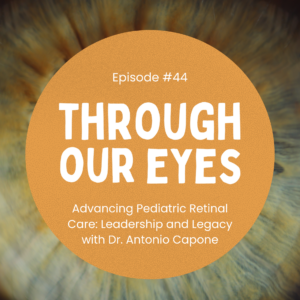
Season 3 | Episode 44
April 14, 2026
Dr. Antonio Capone has spent his career changing what is possible for children with retinal diseases. In this episode, he shares the journey from his early start in psychiatry to finding his calling in pediatric retina, where precision surgery meets long-term impact.
You’ll hear how the field evolved over decades, why severe ROP cases declined, and how training specialists around the world helped bring sight-saving care closer to home for families. Dr. Capone also explains how PRRF expanded beyond research to support parents raising children with rare retinal disease, and why the greatest challenge today is not always medical, but helping young adults move from education to independent, employed lives.
Read Jeanne McClellan’s blog post with Dr. Capone: https://prrf.org/a-conversation-with-dr-tony-capone/
Join us April 17-19, 2026 for a powerful weekend that educates, inspires, and unites. Saturday’s Family Connection Conference brings education and resources to families affected by pediatric retinal diseases, while Sunday’s Hope for Vision Walk brings together our community to fund critical research and programs. Participate in one or both events, either virtually or in person at Oakland University in Rochester, MI: https://prrf.org/upcoming-events/united-in-hope/
You can find more episodes and ways to get involved with the Pediatric Retinal Research Foundation here: https://linktr.ee/throughoureyespodcast
Transcript
Luisa Recchia: Welcome to Through Our Eyes, the podcast of the Pediatric Retinal Research Foundation, where we share stories, conversations and voices that bring hope, understanding, and connection to families living in the world of pediatric retinal disease. Today’s episode is a very special one. We are deeply honored to share a conversation featuring Dr.Antonio Capone, a world renowned pediatric retinal surgeon, teacher, mentor, and compassionate leader whose work has touched the lives of countless children and families. His contributions to pediatric retinal care and research have helped shape the field, but what makes this conversation so meaningful is not only what he has accomplished, but who he is.
In this episode, you’ll hear reflections on purpose, family calling service, and the heart behind a life devoted to [00:01:00] helping others. Dr. Capone’s story is one of excellence, humility, and deep humanity, and we are grateful to bring it to you. Please enjoy this special conversation with Dr. Antonio Capone.
Jeanne McClellan: All right, so we’ll begin at the beginning. How’s that?
Dr. Capone: I think, uh, that’s always a good place to start.
Jeanne McClellan: So that means where were you born?
Dr. Capone: My parents immigrated to the states from Italy and uh,
Jeanne McClellan: Okay, so you are first generation. That’s great.
Dr. Capone: I’m, I’m, and, uh, I was born in Providence, Rhode Island. Um,
Jeanne McClellan: Okay.
Dr. Capone: And the reason is that when my dad came to the States, there were two states in the country where you could.
Practice medicine even if you were on a green card and not yet a full fledged citizen. And those two states were Rhode Island and California. So my parents ended up in Rhode Island and I was born there a [00:02:00] long time ago.
Jeanne McClellan: Well, how long ago?
Dr. Capone: In 1958.
Jeanne McClellan: 1958. Okay. So you grew up in Providence?
Dr. Capone: I did. I grew up in Providence and have two younger brothers and I ended up going to school in Providence.
For college and medical school as well.
Jeanne McClellan: What medical school did you go to?
Dr. Capone: I went to undergrad and med school at Brown.
Jeanne McClellan: Okay. Let me ask you this. What made you decide to become a doctor?
Dr. Capone: I remember when I was in the third grade my dad was a psychiatrist in town and well known, well respected. And I remember hearing so many, you know, great things.
I meet people and they say, oh, is your dad Antonio Capone? And um, uh, I remember I was in the third grade. I was an 8-year-old and, uh. My teacher asked me after posing that question if my dad, my dad was Antonio, and said, you know, are you gonna want to be a doctor like your dad?
And I remember clear as day answering with a resounding yes. And um. [00:03:00] Kind of, uh, from then on, I always liked math and science, so that was kind of the, the earliest thing that I remember. But, the truth of it is, I remember talking to my son about this when he was going through school where he did really well in, in, biology and, and, you know, chemistry and things like that.
But he didn’t really, he didn’t fall in love. Mm-hmm. Um, and when I did those things bio and chem and uh, and math, I really did fall in love and.
But, um, I I actually chem and uh, and math. I really did fall in love and so kind of had an aptitude for it and you know, really sort of, uh, loved and respected my dad and kind of between sort of aptitude and, um, and affection ended up in medicine.
Jeanne McClellan: Okay. And I’m sure your dad was very pleased.
Dr. Capone: Yeah. I think my dad, uh, was pleased, actually, I don’t know if you know this, but, um, I actually started out as a psychiatrist.
Hmm. And, um, [00:04:00] did it for a year uh, when I finished medical school. Psychiatry was really you know, the, the, the crest of biological psychiatry as opposed to, you know, analytic psychiatry. Mm-hmm. Biological psychiatry was really coming of age. Mm-hmm. And I was really between, again, you know, my fondness from my dad and thinking that I might, you know, wanna work with my dad.
And, um, and also psychiatry changed so that it wasn’t gonna be about, you know, whether or not you loved your mother, but, um, understanding the sort of, uh, issues. I thought what a great time, you know, to get into a field that’s going to, you know, be intellectually interesting for my whole career because psychiatry is. You know, uh, becoming more sophisticated and evolving.
So for all those reasons, I went into psych.
Jeanne McClellan: Mm-hmm.
Dr. Capone: And then, so I was at the, at the sort of one of the epicenters of biological psychiatry in the country, [00:05:00] uh, was Yale. And so I went there and there were 22 residents a year, which is a very big residency. Um, half of my classmates had.
Either advanced degrees, you know, PhDs or, or had done another, uh, medical subspecialty, medical specialty already, like internal medicine or pediatrics. So it was a really smart class and, um, I loved it there intellectually, but, um, the day-to-day of taking care of patients on the floor, which, and this was the, uh, biological psych unit mm-hmm.
At Yale we, you know, we did all sorts of, you know, tests on them and, you know, blood samples and things like that. But with regard to the, the day-to-day of, of taking care of folks ended up not being quite the right match of acute and chronic care. That kind of, I don’t know, made me happy. Ophthalmology. My second love in medical school was surgery and the meticulous nature of [00:06:00] ophthalmic surgery really appealed to me and. As you, you know, know you know, there’s a significant sort of emotional, psychological
Jeanne McClellan: mm-hmm.
Dr. Capone: Sort of aspects to vision care, particularly, you know, retina where a lot of the, you know, folks have you know, potentially, you know very vision, impactful conditions, and so mm-hmm.
There’s not a, there’s not a day of my work in, in psychiatry that I don’t use in, in my, my work in retina. Right. So as it ends up, there wasn’t really a misdirection. It really kind of is complimented, you know, my background for what I do and, um,
Jeanne McClellan: interesting.
Dr. Capone: Yeah. So I kind of ended up in a, in a, it all worked out in the end.
Jeanne McClellan: It’s all worked out, no regret. Yep. So, so the ophthalm, how did you get involved in the ophthalmic? I mean, did, did, did it just intellectually appeal to you or had you had some experience doing ophthalmic surgery? That appeal to somehow,
Dr. Capone: I, so actually, medical students get very little exposure [00:07:00] to, uh, ophthalmology.
It’s a sub, it’s a surgical subspecialty, so,
Jeanne McClellan: Okay.
Dr. Capone: We’ll routinely do a rotation in surgery. It’s one of the, the biggest rotations in medical school are usually internal medicine. In general surgery.
Jeanne McClellan: Mm-hmm.
Dr. Capone: Um, as it happened, we’d had, we had some family friends who were both surgeons and so uh, eye surgeons.
And so I spent a couple of weeks with them in my fourth year of medical school. But when I left psychiatry, the surgical specialties that I was considering were, um, cardiac surgery, neurosurgery, and ophthalmology ophthalmic surgery. And two things pulled me to ophthalmology. One is I really like the meticulous nature of the work.
It’s really, really fine. Fine work. Yes. And, um,
Jeanne McClellan: Well, you’re working, excuse me, you’re working on a small organ.
Dr. Capone: Yeah, the suture, su suture we use is finer than the human hair and
Jeanne McClellan: yeah,
Dr. Capone: You know, all of that kind of stuff. So I like them. I liked the impact of it, although [00:08:00] obviously, you know, cardiac surgery and neurosurgery had a greater impact.
But, um, you know, to be honest the, the career path of, of cardiac surgery and neurosurgery from, they really kind of, they sort of overwhelm your life in terms of the, the time, dedication to it and, and, and in candor, I many times in my training have left the operating room after the cardiac surgical residence and after the neurosurgical residence.
But when you do it as an ophthalmologist, it’s I don’t know, this is gonna sound odd, but
Jeanne McClellan: no,
Dr. Capone: um, it’s because you’re choosing to do it and not because it’s so facto. It demands it of you, whether you like it or not.
Jeanne McClellan: Right.
Dr. Capone: And so the fact that I got to pick it was also, it wasn’t like the variable, but was also a variable.
So
Jeanne McClellan: Was your dad displeased with you?
Dr. Capone: Funny. I laugh because of a funny story. I thought, uh, my dad was gonna be disappointed and my mom would like, wear black and go through the house wailing. [00:09:00]
Jeanne McClellan: Being from the old country,
Dr. Capone: being from the old country. And my dad, uh, again, a psychiatrist, uh, when I sat down and told him, he, uh, he, he looked at, looked up at me and he said, you know, I never thought it was really gonna be a good match for you, but I figured you should be able to make your own decision about what you wanna do.
Aw.
Jeanne McClellan: What a
Dr. Capone: great
Dad.
Dr. Capone: I remember thinking, dad, you know, you could’ve told me.
Jeanne McClellan: Really? What do you know you’re doing?
Dr. Capone: You could’ve saved me a year. You
Jeanne McClellan: lost your mind.
Dr. Capone: Exactly. So, um, and, uh, and it was, he was being genuine. I don’t think he was just being, you know, uh, kind I said, said like, you know, if you really loved it and you wanted to do it, you should do it.
If you’d asked me. He said, you know, I don’t know that it’s really quite exactly the right fit for you. And, um, so he, I would say at a minimum, wasn’t surprised.
Jeanne McClellan: That’s really
Dr. Capone: cool. Um, and remained supportive. It is really cool.
Jeanne McClellan: Yeah. He was a great dad.
Dr. Capone: He was that
Jeanne McClellan: he was [00:10:00] able to put his own ego aside and, and have that kind of love and support for you.
That’s great. That’s wonderful.
Dr. Capone: Yep.
Jeanne McClellan: So what was it like the very first time you operated on a little baby and saved their eyesight?
Dr. Capone: So when I was doing that there really was there were only a, a, a very small number, a couple people in the country who
Jeanne McClellan: mm-hmm.
Dr. Capone: Had dedicated re
Jeanne McClellan: pediatric,
Dr. Capone: pediatric retina practices. Yeah. And one of them, and of course, was Mike Trese. And, uh, I, I, I had been a student of his, uh, writings and so, I remember very, very well the first time that I operated on a little baby with retinopathy prematurity. Mm. And ’cause I’d, I’d followed his you know, what he wrote and, uh, and, you know, including you know technique perspectives.
Jeanne McClellan: Right?
Dr. Capone: I remember after the first, I did, after the [00:11:00] first kit, uh, that I operated on, I remember thinking, this is what I wanna do for the rest of my
Jeanne McClellan: life.
Aw, isn’t that great? Um,
Dr. Capone: and, uh, for a long time,
Jeanne McClellan: So it was totally reaffirmed.
Dr. Capone: Yep. And, uh, for a number of reasons, I really think that it is the most technically challenging surgery that I, you know, that I do. And I do kind of, mm-hmm. You know, I do complicated adult attachments. I do mm-hmm. Tumors and hands down the kids are, are the most complicated.
And of course, a child born today has a projected longevity of a hundred years. Yeah. So when you think about impact, the combination of sort of the technical challenge, the impact, and, um, you know, for a long time you know, I, I didn’t get married until relatively, you know, late, you know, in life. And for a long time, you know, these kids were kind of like, they were my kids,
Jeanne McClellan: right.
Dr. Capone: And, um, and you know, really, truth be told, they still are. Mm-hmm. But, uh, kind of all, all that combined, uh, really sort of made it, um, uh, a [00:12:00] bit of a passion play for me.
Jeanne McClellan: I’ll bet. I’ll bet. I bet. It was incredibly gratifying. Yeah. So when you got outta medical school, what, how did, where’d you go first for your practice?
You had a clinical, you’ve had a clinical practice before you had the research arm, correct?
Dr. Capone: Um, well sort of research and clinically evolved hand in hand, but, um,
Jeanne McClellan: okay.
Dr. Capone: So I, you know, I finished my year of psychiatry at Yale and then went to University of Pittsburgh. I did a research year there because I had already done an internship.
So you usually apply for your residency in medical school and the residency begins after your internship for, for most specialties.
Jeanne McClellan: Mm-hmm.
Dr. Capone: And so since I was switching specialties, I was applying for a class that was just finishing medical school so that I had that interval intern year that I’d already done.
And when I interviewed in Pittsburgh, the chairman said uh, you know, I have a [00:13:00] funded lab. Uh, doing research in cornea. And if you want if you have a free year, uh, why don’t you come and work in my lab and I’ll pay you what I pay a resident. And so, which was a very, very generous gift. It had a big impact on my career.
It did get me started in research before I even started my residency. And, um, Richard Thoft was his name. He was a he, he became the chairman in Pittsburgh after being the vice chair at Harvard’s program for many years. And, um, was very, very generous, uh, and, and kind to me that way. And so, uh, and I, I, I worked very hard that research year.
I, it was a productive year in terms of academic publications and then did my residency, uh, in Pittsburgh and my fellowship at, at Emory. And when, when I finished at Emory, I stayed on where’s Emory?
Jeanne McClellan: Where’s Emory?
Dr. Capone: Atlanta, Georgia.
Jeanne McClellan: Atlanta. Georgia. Okay. I know I’ve heard of it, but I never quite knew where it was.
Okay. Atlanta, Georgia. So you’re moving [00:14:00] around a little bit too.
Dr. Capone: Yeah, many people do. In Madison, we are commonly very itinerant until we finished our training.
Jeanne McClellan: Right.
Dr. Capone: And um, and then when I finished you know, I was in a, I had the good fortune to be in a very good place. It was one of the top retina programs in the country, and they paid me that, you know the, the very high compliment of offering me an opportunity to stay as faculty.
And so I did that and stayed at FA as faculty at Emory for 10, almost 10 years. And, uh,
Jeanne McClellan: when you say faculty, does that mean you were teaching?
Dr. Capone: Yeah, I was what were you teaching? I still teach. I still teach now.
Jeanne McClellan: Yeah,
Dr. Capone: I was a. A professor of the Department of Ophthalmology. So I taught medical students and residents and retina fellows,
Jeanne McClellan: Okay.
Dr. Capone: At the, in the university system. And I established the pediatric retina program at Emory.
Jeanne McClellan: Hmm.
Dr. Capone: And and built it up. And so in the beginning I was doing all the kids, you know, in the [00:15:00] Emory system and then you know, because there aren’t very many people who do this kind of work. Right. Pretty soon I was doing, you know, all the cases in Georgia and then I was doing, you know, much of the southeast, um mm-hmm.
And, uh, wanted to build the, the, the pediatric section to be, uh, bigger and bigger and ended up. I was at a meeting, so, you know, over that 10 year period, I started lecturing nationally, internationally, on the topic of pediatric retina in particular. Mm-hmm. Other things, other things as well. But, you know, my, my, my love was the kids.
Jeanne McClellan: Mm-hmm.
Dr. Capone: And, um, ended up, I was at a meeting with Dr. Trese and, uh,
Jeanne McClellan: Yeah.
Dr. Capone: Oh, we were in Greece and mm-hmm. Um, he asked me if I’d, you know, be interested in coming to work with him in Michigan. And uh,
Jeanne McClellan: now he was on the other front. [00:16:00] He was you and he was like the two front runners. Is that right?
Dr. Capone: Yeah, we had a generational difference, but between us right.
And the other people who were well known in our field were maybe another 10 years older than Dr. Trese, who was 10 years older than I at the time, so,
Jeanne McClellan: okay.
Dr. Capone: He was definitely the leading talent. Really popularized pediatric retina, made a lot of the major surgical advances for the most aggressive phases of retinopathy, prematurity, and, and a couple of other diseases.
And so, um, I, in 2000, may of 2000, may 17, actually 2000, I moved to Michigan with my bride of 15 months and my three month old baby.
Jeanne McClellan: Aw, that was a big move.
Dr. Capone: It was.
Jeanne McClellan: Is that what a wonderful opportunity though.
Dr. Capone: Yeah,
Jeanne McClellan: it has been. So, I have a story, I have a story to tell you while we mentioned Dr. Trese.
Dr. Capone: Sure.
Jeanne McClellan: I, one of the [00:17:00] people that I, maybe you, I don’t know if you read my blogs. I, I, I don’t, wouldn’t be surprised if you didn’t. So, um, I do. But, um, one of the guys that I interviewed was my IT teacher who I had for the last couple years who trained me on a JAWS type app, software app and everything Anyway, and he told me his story and he was born in Romania during the revolution, and he was born with detached retinas.
And they knew that if they came to the United States, they might be able to get some help with him. I am not sure how they heard about that. But they came here to Michigan because Dr. Trese was working at, I think, Children’s Hospital at that time, or somehow affiliated with Children’s Hospital. Yep. And that’s who did his surgery.
Dr. Capone: No kidding.
Jeanne McClellan: Wow. That’s how, that is a great story. That’s who did his surgery. Yeah. And he is a [00:18:00] partially sighted guy to this day, but he’s got sight, you know, he’s got some sight and he’s a fabulous IT teacher and was writing code and doing all kinds of crazy things when he was a little kid in middle school and um, is just a little bit of a brainiac in his own right.
And he taught me, he’s worked with me for the last couple years and I still, uh, work with him and he is a really cool guy. And Dr. Trese saved his eyes.
Dr. Capone: That’s a great story.
Jeanne McClellan: Yeah. So that’s cool. So you came here to Michigan and you started working with Dr. Trese.
And at this, at this time, what were you doing then with Dr. Trese?
Dr. Capone: So, um, you know, it was an interesting transition because, uh, when I came here to work with Mike you know, I wasn’t fresh outta school. I, I’d been working for 10 years on my own
Jeanne McClellan: right.
Dr. Capone: So uh, you know, we really pretty much worked kind of side by side.
Um, that’s good. And, you know, I was doing, I remember I was chatting with him [00:19:00] one night about, um, you know, my work and I said, you know, it’s really been, you know, gratifying, uh, you know, building this practice and, you know, come to the point now where in a given day in the operating room, I might operate on kids from two or three different states.
And, and, uh, Mike said, well, it’s pretty much the same, you know, for us, uh, except for on given days, usually two or three different countries. So, you know, he was 10 years older than I, and, uh, and obviously had an, an appropriate, uh, gigantic reputation. And so, um, you know, it the, the stage became wider, mm-hmm in terms of where kids came from, uh, when I came.
But, um, we were, uh, doing at our, in our heyday, 15 to 20 cases a week, uh,
Jeanne McClellan: wow. Of
Dr. Capone: kids from, um, all
Jeanne McClellan: over,
Dr. Capone: you know, regional, national, and international. So the draw was wide.
Jeanne McClellan: Um, and it was not only, not only things like ROP and retinal [00:20:00] standard, if you will, retinal diseases, but cancers, ocular cancers as well.
Dr. Capone: So, no, um, I did the, I had done, um, the ocular oncology, or I had done ocular oncology while I was at Emory. That was not one of Dr. Trese’s interests.
Jeanne McClellan: Mm-hmm.
Dr. Capone: Um, so, uh, but apart from ROP, there are other pediatric retinal diseases that I know you’ve heard of, like, um, congenital retinal schisis. Right.
Persistent fetal vasculature, you know and so forth and so fever. Exactly right. And so we kind of shared the full gamut. Of, uh, or the full range of pediatric vitreoretinal surgical, mm-hmm. Uh, conditions. Mm-hmm. Um, uh, together. And then, oh gosh, after I’d been here about, oh, I think five years or so Dr.
Drenser came, uh, as a fellow.
Mm-hmm.
And, uh, we trained her and she has a PhD, you know, in basically, you know, retinal [00:21:00] genetics and had an interest in pediatric retinal disease and was, was, is a very talented surgeon. And so she joined the team and the three of us really worked together for about 20 years.
Jeanne McClellan: Who would you say is your hero, your biggest hero in your life?
Dr. Capone: You know, I’m lucky. I’ve had, I. I had the privilege to have a number of heroes. You know, truly my, my biggest hero is, you know, my, my parents.
Jeanne McClellan: Yeah.
Dr. Capone: I can’t imagine, and it’s not just because of my mom and dad, I think back, although that’s obviously
Jeanne McClellan: Right.
Right.
Dr. Capone: A big part of, I think back to, well, my parents immigrated to the States in the fifties. I mean, I’m going to date myself, but, um, air travel was not the, oh, you know only way to come back and forth. And by that time I mean, by the time I was 10 years old, I’d gone back and forth to Italy by boat three times.
Wow. And, um, so they were just as likely to travel [00:22:00] by boat, you know, back then. Mm-hmm. As they were by plane. And so my mom, you know, came to the States, you know, as the only daughter in her, you know, family.
Jeanne McClellan: Mm-hmm.
Dr. Capone: And you know, leaving your family to, you know, get married is already one thing, right.
But, um, as an only daughter, but leaving the country and leaving to come to the States was pretty much, uh, we’re hardly ever gonna see each other. And uh, so I just think back. It’s what it was like for that young couple to come to the States and the courage that it took to do that. Mm-hmm. You know, what you were leaving behind.
Jeanne McClellan: Mm-hmm.
Dr. Capone: Um, and then, you know, they built a life from scratch. They knew nobody here. They had nothing when they came here.
Jeanne McClellan: Right.
Dr. Capone: And, you know, they raised three kids, put ’em through, you know, college and grad school and
Jeanne McClellan: Right.
Dr. Capone: Um, really did the,
Jeanne McClellan: really were successful and devoted
Dr. Capone: the full American, American dream thing.
And, um,
Jeanne McClellan: right.
Dr. Capone: And I remember avidly, you [00:23:00] know the, uh, hard work that it took to do that. And the, you know, diligence, saving and, you know, my, my parents grew up during, you know, world War II in Italy. And
Jeanne McClellan: that
Dr. Capone: really kind of impacted mm-hmm. You know, them in a way that stuck really for, for the rest of their lives.
Jeanne McClellan: Absolutely. So,
Dr. Capone: I think, uh, I, I, I, you know, I, hard for me to think of more courageous people, you know? Yeah. That I’ve known firsthand and to my own folks, and I’m really being completely genuine when I say that.
Jeanne McClellan: Right. I
Dr. Capone: understand. And then I have some, you know, heroes in my, in my field one of the fathers of my field is a, a gentleman by the name of Thomas Oberg, uh, one of the fathers of vitrectomy.
And Dr. Oberg was my chairman of my department at Emory.
And when I was at Emory, the department was small and really the people who were there, I mean, were very much my heroes.
So Dr. Oberg [00:24:00] Dr. Travis Meredith.
Jeanne McClellan: Mm-hmm.
Dr. Capone: And Doc, uh, and, and these gentlemen are all still with us, thankfully.
Jeanne McClellan: Oh,
Dr. Capone: Dr. Paul Sternberg and Michael Lambert. They were the retina team when I was there.
And, um. And then Mike Trese.
Jeanne McClellan: So when, where did, so you were functioning with your practice, when, when did, um, PRRF get started? And were you one of the founding docs for that?
Dr. Capone: No. So that started before I got here. So Dr. Trese, the foundation has had, uh, several name changes, uh, as it, as it has evolved.
Jeanne McClellan: And it started like 30 years ago, right?
Dr. Capone: That’s about right. Yep. Right. It was originally, so when I first got here, retinopathy prematurity was still most of what we were doing.
Jeanne McClellan: Mm-hmm.
Dr. Capone: And the reason why I say it that way is that, um, ROP has really changed over the arc of my career. And I mean, [00:25:00] I would commonly do you know oh gosh. At least a half dozen lasers in a week. And on a given operating day, I would do, you know, three to five of the most complicated stage five ROP attachments and stage five surgeries have basically gone away.
And I don’t do six lasers. I haven’t done six lasers in the last two years.
Jeanne McClellan: Hmm.
Dr. Capone: Um, so retinopathy of prematurity has really declined, um, in its prevalence. Largely because our neonatology colleagues have really figured out like the secret sauce in terms of use of oxygen and minimizing other morbidities of prematurity.
So the children are just. You know, do better, um, after premature birth than they used to.
Jeanne McClellan: Mm-hmm. Mm-hmm.
Dr. Capone: 22 weeks still seems to be the wall. You know, I’ve not even today, [00:26:00] you know, we very rarely see a child who is less than 23 weeks. But you know, don’t see, for example, I just don’t see 20 weeks in 20, you know, that kind of thing.
Jeanne McClellan: Mm-hmm.
Dr. Capone: You gotta realize 22 weeks is still pretty young, right? That’s
Jeanne McClellan: right.
Dr. Capone: Five and a half months pregnant, you know? Right. That’s not a lot. No. And, um, so that hasn’t changed. Like the youngest child that you see hasn’t gotten, hasn’t gotten younger over time, but the children do do a lot better.
So, um, ROP is, uh,
Jeanne McClellan: almost obsolete.
Dr. Capone: Uh, yeah. You know, that’s an extreme thing to say, but it does make the point.
Jeanne McClellan: Wow.
Dr. Capone: It does make the point. Yeah. So, you know, for example, we started, you know, we were doing kids from Italy, uh, as a digression, but, you know, we were seeing mm-hmm. Surgery and kids from, uh, from Italy and, um, you know, so over the years we started training doctors from Italy because, um, you know, we felt like, you know, the kids shouldn’t have to come to the states for care.[00:27:00]
And, um, we trained six doctors over there now, and, you know, we don’t really see almost any surgery, you know, from Italy anymore. So we really, we put ourselves out of business in Italy, which was our goal from the beginning. Right. Um, but in any event, so, um, the digression is because the original foundation name was ROPARD for retinopathy of prematurity and allied retinal diseases.
So which means all these others. Pediatric retinal conditions. So in the beginning it was mostly about ROP, and even when I first came here, 85% of what I did was ROP surgery. Um,
Jeanne McClellan: interesting. That’s
Dr. Capone: Interesting. And little, little by little over years, uh, it has, uh, changed names for a while it was the Vision Research Foundation.
And then it evolved to its latest and final, you know, iteration, which is the Pediatric Retinal Research Foundation. So ROPARD, became VRF became PRRF.
As time has passed, now we have a [00:28:00] pretty even dedication to the family of pediatric retinal diseases, um, that require surgery. So we focus on ROP, congenital retinoschisis fever, persistent fetal vasculature, you know, the you know, the, the gamut if you will, of, uh mm-hmm. Coats’ disease.
Jeanne McClellan: Mm-hmm.
Dr. Capone: Um. And, um, stickler syndrome, which is a doesn’t have a vascular basis like a lot of the other conditions. So that was really our focus. These scarring diseases commonly had a, a, a vascular common denominator. Not all, but but, uh, many of them and, uh, you know, a persistent fetal vasculature, ROP fever, Norrie disease, all had a Coats’ disease, all had a vascular basis.
Common denominator, uh, meaning, you know, an abnormality of the development or function of blood vessels.
Jeanne McClellan: Mm-hmm.
Dr. Capone: Um, congenital retinoschisis and stickler syndrome don’t have a vascular basis, but they are, you know they are in the family of, of conditions that we focus on. So the focus of the [00:29:00] foundation, now appropriately, it’s transitioned from, you know, an acronym that had one disease as its primary.
You know, consider the ROPARD to, you know, PRRF, which is not disease specific, but speaks to the category of conditions. And so that’s our focus now.
Jeanne McClellan: Okay. The
Dr. Capone: whole category.
Jeanne McClellan: Okay. And you have, you, you offer a two, it’s sort of a two-pronged mission statement, if, if I may say it that way, right. Uh, it’s research and development and, um, as well as some services, podcasts and family intervention, family support, et cetera.
Would you say that that’s a correct synthesis of it?
Dr. Capone: It’s a hundred percent correct. So in the beginning, the focus was pretty much exclusively on disease, uh, management.
Jeanne McClellan: Mm-hmm.
Dr. Capone: And, and research into the [00:30:00] disease. As time passed, it became clear that, you know, while the quest for cure is, you know, an a noble and appropriate
Jeanne McClellan: mm-hmm.
Dr. Capone: Um, focus it is however, to some degree aspirational in the sense that it’s not just right around the corner. Right. So, while we’re working on, you know, looking into research to address, you know, these conditions treating them and preventing them
Jeanne McClellan: mm-hmm.
Dr. Capone: Results didn’t come quickly and the parents were still faced with, you know, raising, raising their children.
Jeanne McClellan: Right.
Dr. Capone: And, and it became clear that, um, and they often, you know, uh, these conditions were rare. Certainly the kid was gonna be the, their child was gonna be the only one in their school, probably in their, you know,
Jeanne McClellan: world
Dr. Capone: zip code, you know?
Jeanne McClellan: Yeah.
Dr. Capone: May, maybe even their state with their, with their disease.
Jeanne McClellan: Right.
Dr. Capone: And, um, so we started to tilt towards not just research, but also [00:31:00] supporting the community
Jeanne McClellan: mm-hmm.
Dr. Capone: Of people who were raising their children. So, you know, kind of making it a foundational value. So, for example, I would have a child from Louisiana who had the same condition, was the same age as another child from South Carolina.
And so I would. Tell the parents about each other and offer to introduce them to each other if they wanted to, you know, share their experiences and their knowledge and that kind of thing.
Jeanne McClellan: Mm-hmm.
Dr. Capone: So it was acting kind of as a matchmaker and, um, it became clear that there was value to that, that people didn’t have anybody else to talk to about what they had.
This is before the internet, right? Mm-hmm.
Jeanne McClellan: Mm-hmm.
Dr. Capone: So we started, you know, tilting towards community, um, because we recognized that there was a need, like a, a young parent who came in with their child that was a month old,
Jeanne McClellan: right,
Dr. Capone: with a fever, hereditary bowel disease, and was, you know, what, what’s gonna happen [00:32:00] from my child to my child?
Mm-hmm. Will he or she ever go to mainstream school? Will they go to college? Will they have a family? Do we need to worry about, you know, children, you know, grandchildren and so forth? You know, I had families who were 5, 10, 15, 20 years further down that same path. Mm-hmm. And so there’s lots of value to that young family talking to the parent of a 15-year-old
Jeanne McClellan: Right.
Dr. Capone: And saying, you know,
Jeanne McClellan: this
Dr. Capone: is, you can’t underestimate the joy that your child is going to have. You know? Right. It’s just not the end, it’s just a different thing that you thought it was going to be. That kind of thing.
Jeanne McClellan: Right.
Dr. Capone: And, um, and so we were in a unique position because we were connected to all those families.
Jeanne McClellan: Right.
Dr. Capone: To sort of, and, and this, it’s kind of like the matchmaking thing on a, on a, on an, on an in a foundational scale. You know, we basically institutionalized it by making it part of our mission statement. So it’s a long answer to your question, but yes. Responses, research and support the community.
Jeanne McClellan: It’s a great answer to my question.
Thank you for elaborating. So it sounds to me [00:33:00] like that was the psychiatrist in you who was identifying, identifying the need for support, the emotional support and connection
Dr. Capone: Maybe so.
Jeanne McClellan: Yeah, maybe
Dr. Capone: so.
Jeanne McClellan: Yeah.
Dr. Capone: Um, you know, it was kind of happening a little bit in the way that I was mentioning, you know, introductions and so forth kind of organically.
But it, it, it was, you know, I, I will say it was kind of my, um.
Drive to institutionalize it and formalize it and make it part of our culture.
Jeanne McClellan: Mm-hmm.
Dr. Capone: And tilt away from just the mission of research because, you know, in a way, you know, Jean, just talking about research wasn’t doing it for these families because, you know, you joined the fund, you joined the group when you’re, you have a newborn baby.
Your baby, you know, your baby’s now a 12-year-old and you’re still working on supporting the organization for the research that it’s doing, but in the meantime, you have to raise your kid. And so they were, in a way, they weren’t really getting the foundation wasn’t really, not really serving the needs of [00:34:00] our population in a holistic way.
And so mm-hmm. You know, apart from the one-off intros and things like that. So decided to make it a a deliberate focus of the organization, um, as opposed to a kind of, um, incidental thing that Yes, was happening organically, but wasn’t a focus.
Jeanne McClellan: What do you, what would you say is your biggest surprise?
That, of that aspect of the work?
Dr. Capone: That’s a great question. I think
you know, I, I’m mostly surprised, so that was my in, that was kind of my sense, my gut sense and my intuition. I’m mm-hmm. I am mostly surprised by how much traction it’s actually ended up having.
Jeanne McClellan: Mm-hmm.
Dr. Capone: Um, and the number of people who are engaged in the organization who don’t have a family reason to be engaged.
Jeanne McClellan: Mm-hmm.
Dr. Capone: They don’t have anybody in their family who has ROP or fever or, you know, anything that is an eye thing. It’s just the, the [00:35:00] compelling. N sort of
Jeanne McClellan: need you started to say
Dr. Capone: Yeah. Need, need and, and aspect of
Jeanne McClellan: mm-hmm.
Dr. Capone: Um, helping children who have, you know, potentially blinding diseases, uh, and, and their families really resonates with people. Mm-hmm. And, um, I think in many regards, you know, you think about how small, you know, the population of, of kids is, that is the focus of our foundation. Right?
Jeanne McClellan: Right.
Dr. Capone: It really, uh, it’s, it’s you know, the, the compelling story, if you will really, you know, uh, resonates with people, um mm-hmm.
And, uh, once, once they learn about, once people really kinda learn about us, they, they, they’re kind of smitten with
Jeanne McClellan: mm-hmm.
Dr. Capone: With the mission.
Jeanne McClellan: Mm-hmm. Do you have any, do you have any insights or thoughts on the greatest obstacle. That these kids will face being blind or were in a so-called [00:36:00] blind community.
Close quotes.
Dr. Capone: Yeah. I think this will probably resonate with you. I think it’s interesting to see that we have a number of children who are parts of our practice or our community, both. Who, in spite of the challenges with regard to their vision, are very successful at finishing school and going to college, and even getting advanced degrees.
The biggest challenge they have is moving from that educational path mm-hmm. To independent living.
Jeanne McClellan: Mm-hmm. Employment, independent living slash employment slash all of the above.
Dr. Capone: They’re, they’re the same, right. They’re the same to me being employed and living independently. Mm-hmm. And Dr. Dr. Droste calls that the, uh, refers to that as the last rung of the salmon ladder.
Jeanne McClellan: Right. Of what Ladder?
Dr. Capone: Salmon ladder.
Jeanne McClellan: Oh, okay.
Dr. Capone: Are you familiar with Yeah. With the term? Yeah. And, um, you know, they’ve made it through all of these things. Mm-hmm. And, and you also, you know, [00:37:00] b um, realize the incredible advantage that a child who has visual impairment, um, has, if they have a supportive family.
And then the corollary, the huge disadvantage to a visually impaired child if they don’t have a supportive family.
Jeanne McClellan: Yeah.
Dr. Capone: You know, it’s really kind of, you know, brought in, in the sharp focus.
Jeanne McClellan: Not only a supportive family, but a family that is willing to look futuristically, look beyond the immediate, and, um.
See the future, so to speak, in a positive way. I don’t know if that is communicating what I’m trying to say, but maybe you get what I give. I’m getting at Yeah, I
Dr. Capone: completely know what you mean. You see it in the eyes of the parents of a newborn.
Jeanne McClellan: Yeah.
Dr. Capone: And that’s the time when they have the hardest time seeing past because they just see
Jeanne McClellan: blindness.
Dr. Capone: A hundred years of pain.
Jeanne McClellan: Mm-hmm. Mm-hmm.
Dr. Capone: You know? And, and it’s not that it’s, it’s, like I said, it’s different than what they expected, but it’s not the, [00:38:00] the dismal that they expect.
Jeanne McClellan: So what do you think needs to change, Dr. C What do you think it, what do you think needs to change in the sighted world, if we will put it that way, to enable, if that’s the even the right word, enable blind kids or visually impaired kids to live independently?
What, what needs to change?
Dr. Capone: Yeah, that’s a, that’s a good question. And I, I think
Jeanne McClellan: I mean, it’s a whole cultural stigma.
Dr. Capone: Yeah. I’m trying to come up with an answer that doesn’t sound too generic. You know, right. In the sense that you know, an employer needs to, you know, be open-minded about having, you know, someone with significant visual impairment, you know, coming under their employee.
And then be open to making the adjustments so that. You know, the work situation will work for them. And you know, in some regards it’s easy to say that right. And right. [00:39:00] Um, you know, on the other hand, from an employer perspective, you know, those are challenges, you know, an employer, right. You know, just generally don’t want to have to, you know, work on or for the employee.
Right. And to some degree it does require that, it does require someone who is, it does require generativity, you know, towards people to just allow them to, they, they don’t often need the, the help forever. They just need to get started. Right. And then once they’re on their way, they’re fine. You know, they, they find a way they settle in and, and, you know, and we have many members of our community who are, you know, successful, you know, in that regard.
Mm-hmm. But it does, it does require something different, it’s like everything. It’s like what I was saying about, you know the parents need to recognize that, you know, their child’s life can be full. It’s just gonna be full in a different way than they imagined. And kindly the employer, you know kind of needs to imagine, you know, the ways to have a visually impaired employee be [00:40:00] successful.
That may be different, you know, than
Jeanne McClellan: Right.
Dr. Capone: Um. A sighted employee. And you know, that’s, it is in some regards, it’s, again, that’s not what we typically ask of employers, employers in the driver’s seat. And you’re supposed to accommodate to them. Right. Make yourself as employable as possible.
Jeanne McClellan: Mm-hmm.
Dr. Capone: And this is a circumstance where, you know, there need to be employers who are willing to be generative and Right.
Um, to, you know, to tap the talent that, you know, a lot of folks have, even if they don’t have vision.
Jeanne McClellan: Right. And we live in an amazing technology time, which enables a lot more independent skills, which is wonderful. Wonderful. I mean, the technology, uh, however, well I, I’ll put say it this way as an, as an adding on to the point my IT teacher says that of all the people that he teach, and he gets his referrals from the Bureau of Blind [00:41:00] Services.
Mostly he’s got a contract with them. Mm-hmm. Most of the people that he’s teaching all these adaptive computer skills to are not working. They don’t go on and use what they’ve learned. The Bureau of Blind Services is paying for it to get them employable, but they’re not, they don’t go on to become employed.
And when I was interviewing Justice Bernstein for the blog that we did, he, hi. The stat that I always heard when I was working in the disability field was 75% of the blind population or disabled population is not employed. And when I was talking with Justice Bernstein, he said that 80% of the blind community is not.
Not employed. That’s a devastating statistic.
Dr. Capone: It absolutely is. This is Pat Gross’s last drawing of the salmon ladder. Right. Because I mean, in the found in the foundation community, there are some [00:42:00] very bright
Jeanne McClellan: Yeah.
Dr. Capone: PhD PhDs.
Jeanne McClellan: Yeah.
Dr. Capone: Who don’t have jobs
Jeanne McClellan: and can’t find work.
Dr. Capone: Exactly right. And, you know, I, I just don’t,
Jeanne McClellan: I don’t know what we need to do.
It’s, it’s, there’s gotta be a whole cultural shift and I don’t know how that’s gonna take place. I, I don’t know how that’s gonna take place. Do you find that, that in other countries does, is the United States going back more to the medical component and then we’ll talk about the social component? Do you find that in other European countries they still are dealing with ROP and other such things that we are fortunately finding, um, you know, results?
I No,
Dr. Capone: Absolutely.
Jeanne McClellan: Yeah.
Dr. Capone: Yeah. As countries for every. I, I, I get into my soapbox about the infant mortality statistic that, you know, politicians will often use and
Jeanne McClellan: mm-hmm.
Dr. Capone: Um, because not every country defines infant mortality the same way. And so is it a [00:43:00] deceptive statistic? And it makes you think that we have an inferior healthcare system, which, you know, if, if that statistic was the same in every country in terms of how it was defined, then you could use it that way.
But given that it’s not, you can’t, you can’t. And so for example, you’re talking about the low rate of ROP, you know, in the states, you know, our healthcare system is really doing a darn good job.
Jeanne McClellan: Mm-hmm.
Dr. Capone: Um, for these children, you know. But as other con, not every country is at the level of, of technological sophistication that we are, unfortunately, generally for financial reasons.
And, um. In each country as they start to ascend the tech ladder, they go through the same stages of, you know, ROP in their population. So first there’s not much ROP because the kids don’t survive, right?
Jeanne McClellan: Mm-hmm.
Dr. Capone: Um, wow. And then they start to survive and they, and, you know, and, a little bit better, then they start to survive a lot better because they get, you know incubators, but they don’t monitor, you know,
Jeanne McClellan: Right.
The
Dr. Capone: oxygen, oxygen,
Jeanne McClellan: oxygen. Mm-hmm.
Dr. Capone: Right. And then they [00:44:00] have a, and then they have, uh, an epidemic in that, in that country of ROP until they get to the next point, you know? And so what is happening over time is that journey is not as long, it doesn’t take decades to go from, you know, lack of survival to lack of, to survival with lack of ROP, you know, now it can happen over, you know, 10 years instead of over, you know, or not as many decades instead of, you know, 30 years, 40 years.
Right,
Jeanne McClellan: right.
Dr. Capone: So the journey is shortening, but you still see, you know, uh, basically sort of echo. Echo epidemics as countries kind of climb the tech ladder, uh, and begin to be more sophisticated.
Jeanne McClellan: Hmm. That’s interesting.
Dr. Capone: Mm-hmm.
Jeanne McClellan: Very interesting. Yeah. So
Dr. Capone: That’s been a large part of our, you know, participation.
And we’re not the only ones. The whole, the ROP community, you know, worldwide global community participates in this education initiative. You know, to help bring, uh, state-of-the-art care to these kids who live in communities that are, you know, [00:45:00] underserved in that regard. And I’m really proud of that.
The community of specialists focused on pediatric retinal disease and, you know, we had a big part in, in sort of giving shape and identity to that community you know, over the years mm-hmm. Uh, you know, that Trese and Dr. Droeste and I really kind of pulled everybody together and gendered a spirit of.
Sharing of information uh, you know, with the, with the notion that everything we know belongs to the kids that we’ve taken care of, doesn’t belong to us. Mm-hmm. So we share everything. Anybody who wanted to come and spend time in our operating room could.
Jeanne McClellan: Mm-hmm.
Dr. Capone: Um, anybody who wanted to pick up the phone or send an email still can and does.
Mm-hmm. Um, and that generativity is unfortunately not a universal you know, value, uh, in all aspects of, of medicine, but it’s very much a deliberate, active sort of cultural component of, uh, of the pediatric retinal community. [00:46:00]
Jeanne McClellan: Interesting. What you are, you, you are also involved, if I’m not mistaken, with something going on in Switzerland.
Dr. Capone: Yeah, I’ve done some teaching over there as well.
Jeanne McClellan: Oh, is that, is that what it is? You’ve done some teaching over in Switzerland. Okay.
Dr. Capone: Yeah. There’s a European, the European training system doesn’t have fellowships like we have in the United States where if you finish ophthalmology, you wanna become a retina specialist as a retina fellowship.
So they don’t have the same formal fellowship structure. They have more something that is like the uh, kind of apprenticeship paradigm where you finish your ophthalmology residency and then you just work side by side with someone who is accomplished in an area. And then he or she kind of.
Danes when you are done.
Jeanne McClellan: Mm-hmm.
Dr. Capone: Um, as opposed to having a formal, structured, you know, one year or two year program. And then you finish that and you’re done. So a colleague of mine in Italy put together a program uh, [00:47:00] called the European School of advanced uh, ophthalmic techniques or something of that nature.
And, um, I’m just, I’m one of the people who of, you know I think, you know, dozens whom we asked to join that faculty and lecture and eventually, uh, and, and, and teach surgical skills. And eventually the school came to move from being based in Italy to being based in Switzerland. Mm-hmm.
Interestingly, the Italian part of Switzerland.
Jeanne McClellan: Mm-hmm.
Dr. Capone: Um, in a town called Luana. And so I had a faculty appointment there as well.
Jeanne McClellan: Congratulations to you, Tony. What a wonderful career you’ve had. I’m the luckiest guy. Oh, you’ve, you’ve given so much to so many and myself included. I love it. It’s wonderful. God bless you.
What, what’s on your bucket list?
Dr. Capone: Oh, golly. You know, so it’s funny you asked that because I was talking to my brother last night. I don’t, I don’t like the term bucket list.
Jeanne McClellan: Okay. [00:48:00] Well,
Dr. Capone: uh,
Jeanne McClellan: what, what’s left to be done? What, what? Yeah, what’s, what’s left to be done that you would like to see through?
Dr. Capone: Yeah, I like that better.
It’s not, it’s, it’s not just semantic, it’s philosophical for me as well. But anyway I would say, gosh, you know, I think a lot of my work in pediatric retina, um, I. Has, has really come to fruition, has really been done.
Jeanne McClellan: Mm.
Dr. Capone: Um, we’ve trained, you know it, we’re well past the day where there are three or four people in the country who are kids.
Jeanne McClellan: Right.
Dr. Capone: You know, we have. I’m really proud to say that there are many leaders in the pediatric retinal field mm-hmm. Uh, both domestically and internationally. And many, if not most of them have walked through the halls at, at, at a RC or, or amory. That’s awesome. Um, uh, whether just, you know, for a few days or for a couple years.
Jeanne McClellan: And so do you have, do you have a number? Can you even give a number or is it too big?
Dr. Capone: I don’t think I can give a [00:49:00] number, but, and you know, again, now we’re talking about where the denominator used to be, you know, single digits, two or
Jeanne McClellan: three. Yeah.
Dr. Capone: Yeah. And I think now, um. I think probably on the order of a hundred.
Wow. You know, folks nationally and internationally. That’s awesome. Um, one, you know, for some period of time or other you know, we’ve interacted with them, you know sort of, you know, intimately like, you know, coming from person to person and spending time.
Jeanne McClellan: That’s cool.
Dr. Capone: And, uh, you know, I kind of see my, my job now, uh, you know, day to day is uh, you know, working with young people and helping them have as much success in their careers uh, you know, as they can.
That’s kind of mm-hmm. Facilitating other people’s careers is really sort of where, where I’m at now. Mm-hmm. Whether that’s at, ARC with, uh, you know young doctors in, in retina generally, and retina and pediatric retina specifically, or in my corporate role at EyeCare Partners. Where we have a thousand [00:50:00] providers in the enterprise.
And so kind of impacting on other people, uh, helping them be whatever they would like to be. That’s kind of my main focus. But it’s still all about, you know, doing what you can to make the standard of care better and to help people advance in their careers. And, and those, and those are two common denominators to the job at, at, you know, associated retinal consultants being a.
You know, a doctor taking care of folks you know, one-to-one. And then, you know, being in the, in the corporate role and having a broader impact, you know, on all the patients taken care of by all the doctors in the organization.
Luisa Recchia: Thank you for joining us for this very special episode of Through Our Eyes. We hope this conversation featuring Dr. Antonio Capone left you encouraged and inspired. His story reminds us that behind great expertise can only be great kindness and that some of the most meaningful legacies [00:51:00] are built not only through skill and innovation, but through compassion, generosity, and the way we care for others.
Dr. Capone’s impact reaches far beyond medicine. Through his work, his teaching, and his dedication to families, he has helped create hope and connection for so many. We are grateful for his example and grateful to share his story with you.
Here at the Pediatric Retinal Research Foundation, we invite you to continue with us at the Family Connection Conference on April 18th at Oakland University in Rochester, Michigan. That’s a day dedicated to families, connection, education, and empowerment. You’ll find all the details on our website at prrf.org. Thank you for listening to Through Our Eyes. Until next time, thank you for being a part of this community.






 Deutsch
  English
  Español de México
  Français
  Nederlands
  Português
  简体中文
简体中文  日本語
日本語  Русский
  Italiano