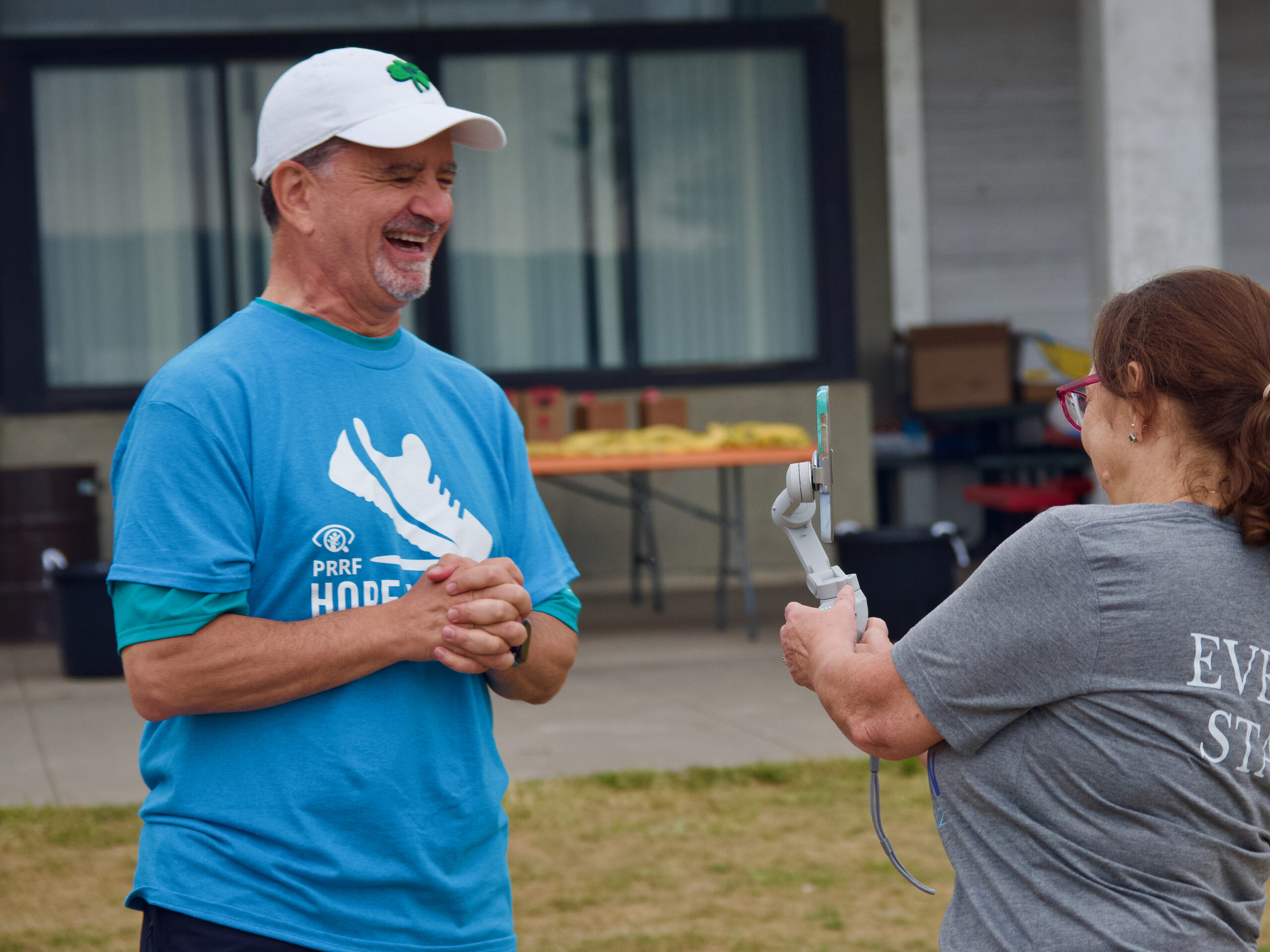
A smiling Dr. Capone wears a bright blue Hope for Vision walk shirt and a white hat. He stands across from an individual in a gray shirt who films him on an iPhone for a social media interview.
Interview by Jeanne McClellan
I am an unabashed admirer of Dr. Tony Capone. So when I asked him if I could interview him for this blog and he enthusiastically and graciously agreed, I was thrilled, but also a little intimidated. He has saved my sight on several occasions, and I’ll admit I have him on a pedestal. But our conversation was a pure joy. He couldn’t have been more forthcoming or down-to-earth.
I learned, for example, that in 1966, at just 8 years old, a teacher asked him if he wanted to grow up and be a doctor like his dad, a beloved psychiatrist. “I remember clear as day answering with a resounding yes,” Dr. Capone told me. “That’s the earliest time I remember wanting to be a doctor.” He adds, “I was always a math and science kid. I fell in love with those things: biology, chemistry, and math. I had an aptitude for them. I also loved and respected my dad, so between aptitude and affection I ended up in medicine.”
After graduating from Brown University Medical School, he went to Yale University for his residency, pursuing psychiatry, just like his father. But the field wasn’t the right fit, and it took some courage to say so. “I was afraid my dad would be disappointed, but he just looked at me and said, ‘I didn’t think it would be right for you, but I wanted you to make your own decision about what you wanted to do.’ I remember thinking, dad, why didn’t you tell me this a year ago!” He laughed at the memory.
Psychiatry’s loss was our gain. His second love in medical school was surgery, and two things drew him specifically to ophthalmic surgery: “I really liked the meticulous nature of the work; it’s incredibly fine work. The sutures we use are thinner than a human hair. I liked the meticulousness of it, and I liked how impactful it is.” After considering cardiac and neurological surgery, it’s lucky for us that he ultimately opted for ophthalmology.
After a fruitful stint at the University of Pittsburgh School of Medicine, doing research and producing academic publications, he moved to Emory University, where his work with children took off. When I tenderly asked him what it was like to operate on a little baby for the first time and restore his sight, he soberly responded, “I thought, this is what I want to do for the rest of my life.” With this epiphany, Dr. Capone’s journey began.
Emory was at the forefront of retinal surgery, and Dr. Capone helped spearhead the development of pediatric retinal ophthalmic surgery. “We were treating kids from all over the southeast United States,” he said. He also joined the faculty, spending a decade doing what he loved most: operating and teaching.
There were very few pediatric retinal surgeons in the world at the time. One of them was Dr. Michael Trese. The two met at a conference in Greece, and when Dr. Trese extended an invitation to join him in Michigan, Dr. Capone didn’t hesitate. “In May 2000, I moved with my bride of 15 months and my three-month-old baby to Michigan,” he said with a grin. “I had been a student of his writings,” he added. “I followed everything he wrote.”
Working alongside Dr. Trese, and eventually Dr. Drenser, they built a practice that treated infants and children from all over the United States and around the world. Dr. Michael Trese has passed on, but Drs. Capone, Drenser and Dr. Trese’s son Dr. Matt Trese, carry that legacy forward at Associated Retinal Consultants (ARC), now part of EyeCare Partners.
As for what drew him so deeply to pediatric work, Dr. Capone was characteristically candid. “I got married late in life, so these kids were kind of like my kids. And truth be known, they still are. That’s how my passion play began.”
Dr. Capone has been affiliated with the Pediatric Retinal Research Foundation (PRRF) since 2009 and currently serves as its President. While the organization has gone through a metamorphosis since it was founded, its current mission is twofold; advancing pediatric retinal research while providing support to families navigating rare eye diseases.
“Often I would have a child with a rare eye disease in Michigan, and another parent with a child with the same rare disease in another state,” he explained. “I would informally get them connected so they would have each other’s support. I wanted to formalize that process so we now provide opportunities for connections for parents and families.” His collaboration with EyeCare Partners has enabled him to spearhead an Innovations arm of the organization, which creates continued outlets for him to initiate valued explorations in the field.
When I asked Dr. Capone about his heroes, he answered without much hesitation. “I’m lucky, I have had a number of heroes. But I have to say it’s my mom and my dad. My parents emigrated to the States in the 1950s. I think back on that young couple knowing what they were leaving behind; they had nothing when they got here. I know the hard work it took to raise three kids, they gave us educations. They grew up in World War II Italy. They ultimately lived the American Dream.” He paused, “There were also many wonderful doctors that influenced me greatly. Of course Dr. Trese.”
Though he now sees patients only a few days a week, teaching remains central to his life. When I personally go for my appointments, there are always medical residents at ARC. Dr. Capone says undergrads, grad students, and others are there as well, to observe and learn. Over the course of his career, he estimates that he, along with his colleagues, have trained over 100 pediatric retinal surgeons worldwide.
When he’s not working, Dr. Capone says, “I always enjoy being with my wife and three (adult) kids. But I am also a runner, an avid fly fisherman, and a hunter.” He is an upland hunter, which means he hunts birds like quail, pheasant, and grouse. His German hunting dog, Blue, accompanies him on his forays.
When asked how he would like to be remembered, he thoughtfully replied, “I think, as creative and kind.”
Dearest Dr. Antonio Capone, you are a living example of those attributes and countless more, and you have many who can attest to your unparalleled sight-saving accomplishments, your soft-spoken kindness, your generosity, and your humanity.
I know I speak for many others, when I say: Thank you, from the bottom of my heart.
_
About the author:
Jeanne McClellan was born and raised in Royal Oak, Michigan, received a master’s degree in psychology, and worked for approximately 30 years as a counselor and social worker until she retired in 2009.








 Nederlands
  English
  Español de México
  Français
  Deutsch
  Português
  简体中文
简体中文  日本語
日本語  Русский
  Italiano