
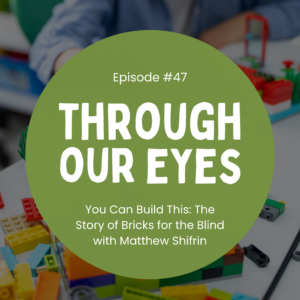
Season 3 | Episode 47
May 26, 2026
Matthew Shifrin was 13 years old when a family friend typed out the first ever set of accessible Lego instructions for him on a braille typewriter. That experience changed everything. A decade later, Matthew founded Bricks for the Blind, a nonprofit that has adapted over 550 Lego sets and now reaches blind and visually impaired builders in more than 120 countries, all for free.
In this episode, Matthew shares the story behind Bricks for the Blind and what it really means for a blind child to be able to build a Lego set independently — the confidence, the joy, the learning, and the sense of belonging that comes with it. He walks through how the process works, why sorting pieces is more important than most people realize, and what he has learned from the builders who write to him from all over the world. He also speaks candidly about what companies and organizations consistently get wrong when designing for blind and visually impaired people, and what it would take to do better.
To explore free accessible Lego instructions, donate, or get involved as a writer or tester, visit BricksForTheBlind.org or email info@bricksfortheblind.org. You can also find Bricks for the Blind on Instagram, Facebook, YouTube, and LinkedIn at @bricks4theblind.
Want to be a guest on the podcast? If you or someone you know has a story to share — whether you’ve experienced a pediatric retinal condition yourself or are raising a child who has — we’d love to hear from you. Reach out to us at throughoureyes@prrf.org.
You can find more episodes and ways to get involved with the Pediatric Retinal Research Foundation here: https://linktr.ee/throughoureyespodcast
Transcript
Luisa Recchia: [00:00:00] Welcome back to Through Our Eyes. Today, I’m excited to introduce an organization that is opening the door to creativity, independence, and play in a beautiful way. Our guest, Matthew, is from Bricks for the Blind, a nonprofit dedicated to helping blind and visually impaired people enjoy building Lego sets through free text-based instructions.
What many of us may take for granted, looking at a picture, following a diagram, seeing where the next piece goes, can create a real barrier for someone who is blind or visually impaired. Bricks for the Blind is helping remove that barrier. Through accessible instructions and a growing community of builders, they are proving that creativity does not depend on sight.
It depends on access, imagination, and opportunity. We’re so glad to have you with us today.
Matthew Shifrin: Great to be here, [00:01:00] Luisa. So I’m Matthew Shifrin, and I’m the founder of Bricks for the Blind. And we are a nonprofit creating accessible text-based instructions that enable blind and visually impaired kids and adults to build Lego sets on their own.
And the whole thing started because when I was 13, a family friend of mine gave me the first ever set of accessible instructions that she typed out on a braille typewriter for me, and it was really an amazing experience because I was able to build a Lego set on my own, completely independently, and as someone totally blind.
Before this, it had just been friends or parents who would help me build, and it was a very arduous and long and painful process because I would have to go around fishing for the pieces in the box, and they’d tell me where they went. And a set that would take a sighted person an hour, for example, would take us four or five.
And it was just an excruciating process. [00:02:00] And after that first set, I realized how much Lego sets could benefit blind kids and how much they could learn from them. Because for me, that first set, this domed Middle Eastern palace, it was really a way to understand more about architecture and the parts of the world that blind kids read about in books but might not have access to themselves.
And it was just a lot of set adapting. And then a few years later, I said that I really wanted to expand this beyond what my friend and I had done. And in 2023, I started Bricks for the Blind, and we’ve adapted over 550 Lego sets for blind builders. And we have builders who are from over 120 different countries, and all the instructions for our sets are free on our website.
Luisa Recchia: That’s fabulous. For someone who’s never thought about Lego building from the perspective of a blind person, what are some of the barriers that you see have come up?
Matthew Shifrin: I think one of the major ones is [00:03:00] just making sure that your pieces are properly sorted. Because if a blind person builds like a sighted Lego builder, they just open up a bag and dump everything out, and then just finding the piece that you need can be very overwhelming.
And that’s why we, at Bricks for the Blind, we provide sorting instructions for each set. And before you start, you would have a sighted friend or a family member or use a service like Aira or Be My Eyes that provide remote assistance to help you sort the pieces for every couple of steps into separate containers so that you can build with the speed and the agility of a sighted person.
But another thing that I think that blind people, uh, rather sighted people may not have considered is just the educational opportunities that Lego sets afford blind people. I was at a place recently, and they had a Lego Space Needle on display. And it was very interesting, because I [00:04:00] had assumed that the Space Needle in Seattle was just a needle-shaped building that looked like a knitting or a sewing needle standing up.
No. It looks like someone plonked a UFO onto this kind of tripod-like pole with these girders that are, um, kind of sliding inward into the main support structure that holds up this UFO. And it’s very interesting, because these structures are not something that I had had personal experience with, like the domed Middle Eastern palace.
These are experiences that blind kids just cannot have. They can have, uh, artificial intelligence, for example, describe something to them or read a Wikipedia article or read a book, but that’s really not the same thing as the hands-on experience of being able to build it on your own. And also for the blind child or young adult or whatnot, this is really a quintessential part of childhood that they are [00:05:00] now able to access.
Uh, so to recap, for the sighted person, they may not have not considered the sorting process, or just more generally that for blind children, Lego is not just a hobby or something to do when they relax, but much more edutainment than just building a thing.
Luisa Recchia: What does it mean to a blind or visually impaired builder to be able to complete a Lego set independently?
What does that mean to them?
Matthew Shifrin: We’ve had so many emails come to us from blind kids, adults, senior citizens all over the country, and what keeps coming up in these emails is just the joy that they experience from being able to build on their own. And to them, it means not just this toy- But this experience that so many other people have had, not only is it the joy of completing a set, which they definitely do have, but [00:06:00] our blind children who write us, they say, “You know, my friends were all into Lego, and I couldn’t build before, and I didn’t really know what all the fuss was about.
And now I’m begging my parents for Lego sets for my birthday and for Christmas because I get it now. I’m hooked. You’ve made me a Lego addict. “How dare you,” they say. And so that’s definitely one thing. But also for older blind adults, we’re seeing the joy of how it brings their family together. They say, “My pa- uh, my, my husband, for example, he builds with our kids all the time.
And I used to just kind of sit by idly fiddling with a couple of pieces. But now I get to steal my husband’s fun.” “And it’s wonderful to be able to commandeer the Lego building activities and be able to really help my kids out. I mean, the fact that they don’t want help, that’s a different issue.” But, and also the interesting thing is we hear from senior citizens, and they’re saying, “You know, my kids, I couldn’t [00:07:00] help them because, well-” Mm-hmm “… Lego instructions didn’t exist. But now I get to spoil my grandkids. They come over, I get to build with them. I teach them something about the world and how it works.
They teach me something about the building process or how different pieces are used, or it’s just a wonderful way for us to unwind with our families and kind of talk through our day, like what you’d see at dinner. But also we get to just build through whatever issues we might be having. And it’s a wonderful way for me to relax and calm down, but also really spend some great time with my grandkids and really feel like we are more connected than we were previously as a family unit.
This is our thing now.” Which is really wonderful.
Luisa Recchia: Well, walk us through the process. If someone receives a Lego set and wants to use Bricks for the Blind, what do they do first?
Matthew Shifrin: I mean, first, please check that the set that you’ve got is accessible on our website, just because we simply do not have the [00:08:00] manpower right now to adapt every single Lego set.
Um, and- So first, please check that it is accessible. If not, please email us and we will do our best to adapt it if we can. But please don’t expect an Eiffel Tower or a Colosseum from 10,000 pieces because that’s just not happening at this point in time. But, um, once you get that set, download our instructions from Bricks for the Blind.
Uh, they are free. And then if you can, please have access to a sighted person to sort those pieces. If you don’t have sighted access, use Aira or Be My Eyes, though please note that that might take a little bit longer because they are relying on what your camera is seeing. And then, uh, once all the pieces are sorted, also please start small if you can.
Don’t start with 1,500-piece sets because, in my opinion, Lego is very much like learning an instrument or learning a language. We cannot [00:09:00] expect a beginning pianist to play, I don’t know, Rachmaninoff Second Piano Concerto because that thing is just really complicated. Yeah. And so start small, start easy.
And then I would suggest also have those instructions available to you either using a screen reader or on a braille display, or if you have enough usable vision, you can magnify them, whatever’s easiest for you. And I would suggest for that first build to have a sighted person on hand just in case, uh, because what you’re going to see is, because there are a lot of new names that you have not encountered before for different pieces, it’s very helpful to have them, uh, them as in the sighted person around, just so you can call them over and say, “Hey, I think this is a two by two plate with a pinhole sticking up.
Could you just check? I’m on step 47.” And then they can check and be like, “Yeah, that’s the right piece.” And the reason I advocate for this is just so that they can help you get a head start on that Lego [00:10:00] building vocabulary. The good thing about Lego is that a piece is always the same piece. They don’t transform.
So a one by one with a side stud, a bump on the side, is always going to be that piece. Once you’ve learned what that piece is, it’s not gonna change. And so once you have that sighted person there and able just to pop in and check on you, then just start building and really enjoy the process. And I mean, at first it might be a little bit difficult.
It might take a little time just to get into the flow of it. But what our builders also really love is the fact that- And gets them into a flow state, like what you might see with, uh, people practicing a sport or playing a musical instrument or playing a video game or whatever. They are completely engrossed in that activity, and nothing else can touch them because that’s just what they’re focused on.
And we find that really helpful for blind builders because it really helps them relax and just completely be taken [00:11:00] up by this activity, have their brain completely full of it. And so basically enjoy the process. And then once you’re done, display it, show it off, have your kids or your nephews or whoever play with it, and then get your next set.
I mean, our goal ultimately is to cultivate the next generation of blind Lego fans. And if you like it, then keep going. And if you don’t like it, that’s also totally fine.
Luisa Recchia: So, uh, you know, you mentioned, uh, sorting the pieces first. Why is that step so important?
Matthew Shifrin: Uh, two reasons. Lego tend to have basically, one is to make sure that you don’t have to slog through bowls upon bowls of pieces. Let’s say a set has two bags. If you wanna be adventurous, you can open those two bags and dump them all into a big bowl and have at it trying to find whatever pieces you need. That is going to take you hours. It even takes sighted people hours.
So it depends on how much time you [00:12:00] wanna save. Do you wanna build with the speed of a sighted person, or do you wanna really torture yourself and treat this more like a brainteaser? But also, the reason that sorting is important is from a perfectionist standpoint. Because, for example, I display my Lego sets.
A single bag might have, for example, two-by-two bricks that are four or five or six different colors. And if we want to treat Lego building like a perfectionist activity, and if we want to display our sets, then we would want to sort these bricks into their corresponding steps so that we don’t have to mix up colors, and so we can have some more pride in saying, “Hey, I built this exactly like the instructions advocated for.”
However, we do have some builders who just say, “You know, I don’t care if my rocket ship is multicolored. I just care that I built it on my own.” And that also is a completely valid way of doing things. But I think sorting is important also just to de-stress the blind builder so that [00:13:00] they don’t have to worry about dealing with bags upon bags of stuff.
Luisa Recchia: What a great tip. And not only for those, uh, that are visually impaired. How do you decide which Lego set to create instructions for? How do you, how do you decide that?
Matthew Shifrin: We’re trying to keep a balance between the different types of Lego themes that we’re adapting because Lego have very many different series, Friends, Animal Crossing, Fortnite, whatever, and we want to cut a large swath of those sets.
And we wanna make sure that a builder will have something that might pique their interest. We wanna make sure that we have Sonic the Hedgehog sets, but also Harry Potter sets and Batman sets and Spider-Man sets and whatever. And we might not get all those sets, but we wanna make sure that the builder will have characters and building experiences and opportunities that they relate to.
Uh, our adult builders are always very grumpy because they say, “You know, all these [00:14:00] sets are for kids. We want 3,000-piece space shuttles.” And we say, “That’s wonderful, but we want to nurture the next generation of blind Lego fans, and you guys are experts. But if we want a builder who’s just starting out, we will not start them on a 3,000-piece space shuttle.
That’s just not realistic. Just because a sighted person who can see the picture can start with such a set, there will be a steeper learning curve. So we… You guys have fun, but don’t expect miraculous, massive things from us because those take a long time to write.” And it just makes much more sense for our writers and our testers to adapt smaller sets that we can, that can reach more people than larger, more niche products.
And so basically all I’m trying to say is that we adapt sets based on just a different variety of themes and building levels from younger builders to experts, and also just flavors in the sense that, uh, we [00:15:00] want to give blind people a sense of the different parts of the world that Lego can teach you about.
So we have a Paris skyline, we have a London skyline. We have the tranquil garden, for example, that’s kind of a Japanese style garden, but we also have donut trucks and police cars and space shuttles because we want to give blind people… And a bunch of flowers also. Goodness, our Lego make these botanical sets, and they are flying off our website, not only off the shelves of toy stores.
Because blind adults and teenagers especially, they’re like, “You know, these are great. They’re a great starting point. Give us more flowers. More, more, more.” So those are also very popular, not only because they’re flowers, but also because they teach something about the world around you that blind people may not have access to.
And so basically, we are trying to walk a balance between getting, uh, blind people to engage with these different characters and book series and whatever, but also give them the opportunity to learn about the world around them through architecture or building [00:16:00] Batmobiles and learning about the parts of the world that they might not have access to, uh, on their own.
Luisa Recchia: What have you learned from the bi- blind builders who use your instructions?
Matthew Shifrin: I’ve learned that the world is not as obvious to a blind builder, uh, due to the lack of insight that they might have about the world around them. And mind you, I knew this because I’m blind myself. But from a sighted standpoint, sighted people might not realize this because of the sheer amount of insight into the world that they’re getting because they can see the world around them.
I had a kid, seven or eight years old, I was building a car with him. And he said, “Wow, I get what a windshield’s for. It’s not just the glass thing that my parents look through when they’re driving the car. I didn’t realize cars had this,” he says. “But I get it, it actually shields you from the wind. And you see through it, and you understand what’s in front of you on the road ahead.”
And this kid just had not had access to [00:17:00] a model of a car in such a scale where he could attach this item to the vehicle, and then realize what it did in context. And I think this contextual learning is also really important because what you have with Lego sets is that you build parts of them, and then everything comes together.
And when it comes together, the blind builder really has a full sense of what this is and how it works. And for blind kids especially, that’s really, really important because of that lack of sight information. And just because they can read about something in a book doesn’t mean that they have lived that experience and that they’ve experienced it fully.
Um, I had a, a kid get really excited about axolotls. We have a Lego set where there’s a boat with little axolotls. And he said, “Wow, I didn’t realize they live in the water. And man, they’re so cute. I wanna get one now.” And just like little learning moments like that. I also found it really interesting.
Personally, I was building the Paris set, [00:18:00] and I didn’t realize that the Louvre had this big pyramid in front of it. Just not something I knew. And I was like, “Wow, that’s one big pyramid. Okay that’s good to know.” Also, it’s just really interesting to see the, uh, different Parisian different Parisian buildings.
There’s one whose name I’m blanking on, but it looks like, um… It’s like if you cut the ends off an oval and you stood it upright. It’s one of the skyscrapers. Blanking on its name. But with these skyline sets, it is very interesting to build them and to just learn more about just standard architecture stuff that a sighted person would say, “Oh, yeah.
Well, thank you, Captain Obvious. I knew this. Of course I knew this. Everybody knows this.” But again, for the blind person it’s really cool. The kid didn’t realize the Eiffel Tower had legs, for example. Hmm. And he was like, “Wow, it’s got legs.” I’m like, “Yep. It has four of them.”
Luisa Recchia: Wow. It’s, uh… I mean, this sounds like m- much more than just [00:19:00] building a Lego set. Uh, it, it, sounds like Lego supports confidence, independence, patience, or even relaxation. Where have you seen that?
Matthew Shifrin: I’ve seen it everywhere. I’ve seen it. There was a great moment where I was teaching at a summer camp for blind kids, and I blindfolded them all.
And I said, “Okay, we’re gonna build this go-kart. You have an hour.” Half an hour into it, they say, “Uh, sir, we’re done.” And I said, “What do you mean we’re done?” And they said, “Well, we finished.” And I said, “Oh, great. Now I have to go out and get them a harder Lego set.” So I got them a harder Lego set, and I thought, “Okay, I’m good.
They won’t be able to finish this.” 45 minutes later, “Sir, we’re done with this one, too.” And I’m like, “Oh, man.” And then I asked them, “Uh, guys, I’ve heard that you guys have some usable vision, right?” And they’re like, “Yes.” And I blindfold my builders. And I’m like, “Are you guys sure that you had your blindfolds on the whole time?”
[00:20:00] And they’re like, “Well, no.” And I’m like, “That explains how quickly you built. Blindfolds, put them back on now.” And, uh, all I’m trying to say with this is I think that Lego promotes independence, relaxation- Yeah … confidence, all this stuff, but I think one department where accessibility is sorely lacking, in my experience, is fun.
And now young adults and teenagers on this show can attest to the fact, uh, listeners can attest to the fact that you guys are stressed. You guys are stressed a lot. You guys are stressed all the time. Not only do you guys have homework, but you guys have extracurricular activities, preparation that you need to do, college application essays to write sports, whatever.
And relaxation is a distant memory for you guys. And Lego is just an opportunity to really help people just focus on a single thing, and it’s fun. [00:21:00] And I think that fun is so important because- Even getting from classroom to classroom can be stressful for, for blind kids. I remember I had to… There were kids who were looking at their phones when they were walking down the hallway.
I had to cane smack them so they would not crash into me. I had people trip and fall because they weren’t looking where they were going. I threatened to bring a bike siren to school because people would not move out of my way, and then the principal miraculously made it so that they would move. It was the loudest, most obnoxiously annoying object that I could think of.
Why am I telling you about bike sirens? Simply because school is stressful. Life is stressful. Lego is a rare opportunity to not only relax, but just to feel like you’re part of something bigger than yourself. You’re part of maybe a childhood experience that you did not have. A lot of our fans are people who could play with Lego as kids, for example, but then they lost their vision later in life.
And they’re saying, “You know, it’s wonderful to be able to return to this [00:22:00] hobby that I loved 30, 40 years later.” And even people in their 20s, they’re saying, “You know, I used to have vision. I couldn’t build for years. Now I can. It’s great.” All I’m saying is that it promotes confidence, independence, relaxation.
Also, assistive technology skills and just making sure that you are up on your braille reading. If you’re someone who is grumpy about having to learn braille, if it’s hard for you, I hope that this can motivate you to get out your braille display and read the instructions and apply what they say to the build process.
But also just get a sense of the fact that y- there is more confidence in your life than you might think. I mean, building Lego sets, you mentioned confidence, of course, but it’s a great confidence booster as well, knowing that, hey, it might have taken you a little bit longer than a sighted person, but you did it.
You can display it. You can be proud of it, and you can learn something from it.
Luisa Recchia: Amazing. What would you say to a parent, teacher, or therapist who may not realize this kind of activity is possible for a blind child [00:23:00] or adult?
Matthew Shifrin: I would say that it’s definitely possible, and it will enrich your child more than you can ever know. Mm-hmm. And even in the case, let’s say, if your child has multiple disabilities, even with higher support needs, there are definitely ways to still get them building and engaged with Lego as a medium.
Luisa Recchia: Matthew, how can people find and use your instructions?
Matthew Shifrin: Our instructions are all free on the Bricks for the Blind website. And we are at bricksfortheblind.org. There is an instructions page which lists all our instructions. You can search them by a set, by the size of it, by the theme of it, and the- the difficulty level of it, and just go to bricksfortheblind.org/instructions, and you’ll find all of our sets there.
And that’s how you find us. We’re also on Instagram and [00:24:00] Facebook and YouTube and LinkedIn. All of those are @bricks, the number four, theblind. But our website is bricks F-O-R the blind, so no fancy number shenanigans there.
Luisa Recchia: Perfect. Uh, do you use volunteers or donors, testers, writers?
Matthew Shifrin: We love them. Okay. We need them dearly. Because without writers who write these instructions, we are toast. Because basically the way it works is we have sighted writers, we have blind testers, and our… both of them, this is basically paid volunteer work. So we assign you a set.
Uh, the sighted writer’s going to write it, and we are going to, after we get it to a blind tester, they test it, the writers revise, post it on our website, then writers get paid and reimbursed for the set that they built. So it’s basically free Lego. Same thing for the blind tester as well. And from a donors and volunteers standpoint, absolutely, we are [00:25:00] completely donation-based, and every dollar goes directly to making more Lego sets accessible and enjoyable by blind people.
We have a GoFundMe on our website, if that helps.
Luisa Recchia: Okay, that was gonna… I was gonna ask that as well. So if anyone, uh, who’s listening is interested and would like to volunteer or be a tester or a writer is all that on your website as well?
Matthew Shifrin: Yes. The easiest thing to do is use the Contact Us form on our website.
We are at info@bricksfortheblind.org, and all that would just be the easiest way to do it.
Luisa Recchia: Beautiful. If someone listening knows a child, adult, classroom, or an organization that could benefit from Bricks for the Blind, what should they do next?
Matthew Shifrin: Get it out to that child, parent, organization, or classroom.
Um, for the child, if you have a [00:26:00] child that you know of, just do the prep work in advance, meaning get the set, sort the pieces so that the kid doesn’t have to worry about it. And if you have access to this child, then- I mean, your first step is getting them hooked on Lego. How do you do that?
Just sit with them and walk them through the build. Read them the instructions if that’s easier, and just be there as kind of a steadying force, as a helping hand, as a person who can mentor and guide them through the building process. And once they’ve built one set, I guarantee you they will not stop. Mm.
Um, and then for the organization and the classroom, same thing. Blind adults, same thing. The main goal is just to get people interested. If there’s a classroom, tell the teacher. Send them a link. Get them, if you can afford it, purchase them a set so that they can kind of do a group build, for example, with their classroom.
I don’t know. If they have five kids in the classroom, [00:27:00] divide it up so that each kid gets to do, I don’t know, two or three steps, and then just cycle from kid to kid. Organization, same thing. And it’s just really about spreading the word because we want to get the word out to as many organizations and schools, institutions and children and adults as well as possible.
And I think the most important thing to emphasize is the fact that blind kids can do this. Blind adults can do this. And not only can they, but they love it. And spread the love. It’s that simple.
Luisa Recchia: What does Bricks for the Blind teach us about accessibility in everyday life?
Matthew Shifrin: Bricks for the Blind teaches us that accessibility is easy to implement, more so than people might think. And all it takes is just a thought about how a seemingly inaccessible toy or product or service can be [00:28:00] modified to be accessible. What I mean by this is that you don’t need entire departments. My friend and I, we started out of our living room.
And all our testers are just… or rather all our writers are just random folks from wherever. We have them all over the world: Portugal, England, Spain, France, Germany, Austria. And they’re just people who love Lego. They’re not experts. They learn by doing on the fly. And I think that this kind of learning by doing, it’s really not that difficult-ness, is what has made Bricks for the Blind thrive and what has made us grow because people, they just want to do this.
They have a goal, they have a mission, they have a task. And all I mean from an accessibility standpoint is that it’s much easier to implement. All you need is just a bit of creativity.
Luisa Recchia: What do companies and organizations often miss when designing products or experiences for people with visual impairments?[00:29:00]
Matthew Shifrin: Oftentimes companies miss running those experiences or products by blind people. I was at a tech conference and was very entertained. There was a refrigerator on display which had braille labels that were supposed to tell you how much water you were supposed to, uh, select to pour into your glass or water bottle.
And there was 4, 8, 12, 16, and 32. These braille labels were miswritten. 16 was 17. Does that matter in the grand scheme of things? Not particularly that you have an extra ounce of water. But it shows that the company did not run these braille labels by a blind person to make sure that 16 said 16. And this also matters because this makes checking and reading things sometimes very difficult.
I was at an art museum recently and they had a brailled plaque on the wall- Which was lovely, but it was at such [00:30:00] an unfortunate angle that a blind person had to squat down on and bend backwards, almost doing a bridge, to be able to read this plaque from beginning to end. And that’s just a matter of a company not quite realizing that the blind person they read differently.
They need stretchy arms and bend them at certain angles to do this. All I’m saying is that accessibility companies hopefully, I hope that they will be able to vet more of their products and experiences by blind people. And not all companies, mind you, but these are just the most jarring examples that come to mind of, oops, we didn’t vet it with a blind person and run it by them.
Luisa Recchia: Such wonderful information, and I hope those listening that are running companies or organizations from, in many aspects can take that tip and feedback from you. Very much appreciated. What would you like to see more toy companies or creative industries do [00:31:00] differently?
Matthew Shifrin: It would be wonderful if toy companies and creative industries were able to, from the get-go, think about the different demographics that were being served. I mean, I can only speak to a disability standpoint, and really think about what could you do, what simple fixes could you have to more easily engage those demographics that you might not have thought of.
For example, some games might be made accessible simply by making your dice tactile. And bam, accessible board game. Not much work. Or incorporating, for example, QR codes into your tags… Or rather, apologies, QR codes onto your cards that will lead to a website that will have the info of the card on it so that you are able to then, um, to then read the text on that card.
And just a little tactile marker on the corner to [00:32:00] demonstrate that there’s a QR code there. Not very difficult to implement, and makes it fully accessible. But that’s just in the case of board games, for example. Uh, but I think generally just thinking outside the box into how an experience can be modified for blind people, but also does this take away from the overall experience of the product?
So if you have, for example, basically when does a product- Become a completely different product because accessibility has been bolted onto it. So for example, if we have a video game that is, for example, a shooting game, and you guys have been able to make it accessible, but now it takes blind people significantly longer to play and the playing process is slower and more difficult and more irritating for the blind player, and now the complete method of the game and the way it’s played has been changed completely just to make it accessible.
Is that worthwhile? [00:33:00] Would that give the blind player the same experience as the sighted one? I would argue that it wouldn’t. So then if you face such a situation, it’s valuable to go to the blind people and say, “Okay, we’ve made this accessible, but the complete method of play is completely changed. What would you guys like us to do?
Would you guys like the slower method, or would you guys like some sort of faster sound-based cues that might give you less of a full gameplay experience but will allow you to play at the speed of a sighted person?”
Luisa Recchia: what other ways can sighted people become better allies in making hobbies, play, and learning more inclusive?
Matthew Shifrin: I think it’s very important to approach hobbies, play, and learning from multiple standpoints. And if you have a disabled person in your life, just try a hobby from their perspective. If they’re blind, try whatever hobby you’re doing with your eyes closed, and think about what could be implemented to make the hobby more accessible, and then run [00:34:00] that by your blind friend, and then try some sort of ad hoc solution.
And learning can be fun. Hobbies can be fun. It’s just oftentimes they are not thought of as something that blind people can participate in. That’s just not something folks think about, which makes a lot of sense because unless you have a blind friend or child or whatever, it’s just this ambiguous thing out there in the distance that you have no relationship with.
And so the way to be a better ally and make learning more fun is just to approach it from the blindness standpoint, and then also more generally think about what’s causing the fun. Why is this fun for you? And if you realize that this activity is not fun for blind people and cannot be made fun, what’s an alternative?
Luisa Recchia: What is your vision for the future of Bricks for the Blind?
If you can tell our audience once again.
Matthew Shifrin: Our future is to nurture the next [00:35:00] generation of blind Lego fans. Be they kids or adults, we want people to really feel like this is a hobby for them, that they can fully engage and participate and enjoy and learn something from.
Luisa Recchia: What’s one thing you hope listeners remember from today’s conversation?
Matthew Shifrin: Lego building is fun. You can build this. That’s really… I, I joke, you can build this. But at Bricks for the Blind, that is our slogan. You can build this because you can.
Luisa Recchia: So Matthew, what gives you hope when you think about the future of accessibility, inclusion, and opportunities for people who are blind or visually impaired?
Matthew Shifrin: The energy and enthusiasm of these people is what gives me hope. The builders who write us, who are thrilled by this, and also the fact that we see a lot of blind people as experts in these endeavors.
A wonderful example, for example- Is [00:36:00] Glide, which is a wheel-based navigation solution for blind people. And it’s basically a motorized walker that will circumnavigate you around obstacles, and has GPS in it and other technological doohickeys. But it’s basically used as a possible replacement for a cane or a guide dog.
And I bring it up just because Amos Miller, the founder of it, is blind himself. He has the lived experience to be able to run this tech company and create this product that blind people find value in, that blind people love and enjoy and are passionate about. And the passion of these blind creators and founders is, I think, what is so energizing to me.
But also the fact that the accessibility landscape, thankfully, is shifting towards accessibility in a more universal form. We’re seeing screen readers implemented into video games, for example. But besides that, we are seeing blind people who are just [00:37:00] taking video games that they have wanted to play for years and they’re making them accessible because they can.
And I think that kind of ad hoc we can do this mentality is really what drives innovation in accessibility.
Luisa Recchia: Before we close, one more question. Is there anything I haven’t asked that you’d like to share with our listening audience?
Matthew Shifrin: I would encourage, if you guys have any questions, if you’re parents of blind children, if you’re teachers or blind young adults, whoever you are. If you have any questions for me about Lego or just generally, reach out, please. I’m here. I mean, I have retinopathy of prematurity. I was born significantly early.
And all this just to say that I’m here for you folks, be it Lego or other things. Just shoot me an email and I will do my best to help out [00:38:00] with whatever building issues you might be facing.
Luisa Recchia: What a wonderful reminder that accessibility is not just about removing barriers, it is about opening doors. Today we learned how Bricks for the Blind is helping blind and visually impaired people experience the joy, creativity, independence, and confidence that can come from building LEGO sets.
Something as simple as translating visual instructions into text can create a completely different experience for someone, one filled with possibility. To learn more, explore their free instructions, donate, or get involved, visit bricksfortheblind.org. Thank you for joining us on Through Our Eyes. We hope today’s conversation inspires you to think differently about access, creativity, and the power of making everyday experiences available to you. Now I’d like to thank our sponsor, PRRF, the Pediatric Retinal Research Foundation. And if you’d [00:39:00] like to get involved or be a guest on our podcast, please email us at throughoureyes@prrf.org.






 简体中文
简体中文  English
  Español de México
  Français
  Deutsch
  Nederlands
  Português
  日本語
日本語  Русский
  Italiano